
Auvergne-Rhône-Alpes organizes interdisciplinary collaborations
One of the objectives of the Plateforme nationale pour la recherche sur la fin de vie is to encourage the emergence of local multidisciplinary research. Auvergne-Rhône-Alpes is one of the regions where such collaborations are taking shape. Since last year, three research projects involving medicine, the humanities and the social sciences have been launched.
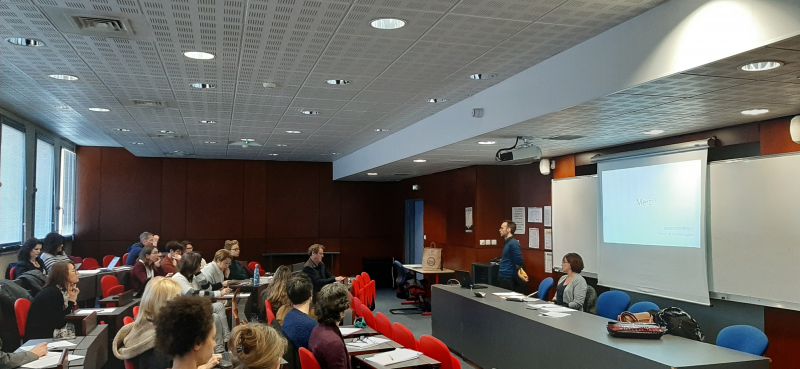
On February 20, a third meeting between caregivers and researchers in the humanities and social sciences was organized at the MSH1 in Clermont Ferrand. Virginie SAGOT, coordinating physician for the mobile palliative care team at the Issoire Brioude hospital centers, initiated these meetings. She recounts: Two years ago, the MSH and the hospital were already collaborating in the healthcare field with a research project on discourse in the doctor-patient relationship, in which I was involved. When I told him about the Platform, the director of the MSH was very interested in its multidisciplinary aspect and the prospect of seeing the laboratories working not side by side, but together. An initial information meeting on the Platform and its national directory of researchers was held on March 27, 2019. We met again on July 2, to get to know each other through a presentation of each other's work, and to start identifying our main areas of research. On February 20, we continued our presentations and discussed how we could work together around these themes.
"Humanities researchers are highly motivated by the possibility of conducting field research with concrete actions to improve the quality of care"
These successive meetings were coordinated by MSH director Jean-Philippe LUIS, Mylène BLASCO, teacher-researcher at the Language Research Laboratory (LRL) and Virginie SAGOT. The discussions led to the launch of three main research projects. Caregivers, education researchers, legal experts and philosophers are working together on the issue of advance directives3. They are looking at what these directives reveal about the way people conceive of death during the course of their lives, and reflecting on what these advance directives could bring to the person who has drawn them up, his or her loved ones and caregivers. A second project focuses on end-of-life decision-making within healthcare teams. It brings together literature researchers, linguists and caregivers. Literary writing workshops are held for caregivers. The reading of literary texts and the practice of writing give the opportunity to express "another voice", to question representations of the end of life, of death, or to understand what can cause difficulties in the care relationship in practice, in speaking out in difficult situations. Finally, cognitive psychologists and doctors are working on support, spirituality and self-awareness. The aim is to show, for example, how meditation and the reinforcement of positive emotions can improve the condition of people at the end of life. Researchers in the humanities and social sciences are highly motivated by the possibility of conducting field research with concrete actions to improve the quality of care
, notes Virginie Sagot.
The Platform's directory has identified around 40 people working in the end-of-life field in Auvergne-Rhône-Alpes. Even if everyone expresses a desire to work together from an interdisciplinary perspective, it's hard to 40! That's why we've organized sub-groups that will think together around three lines of research defined on the basis of work already initiated and disciplines represented.
The lines in question are: La mise en mots de la fin de vie : l'écrire, la dire, la parler ; La temporalité de la fin de vie et enfin L'identité professionnelle. The fruit of these reflections will be pooled at the next Auvergne-Rhône-Alpes meeting, to be held on October 15.
- Maison des sciences de l'homme (MSH). MSHs are service and research units dedicated to supporting research in the humanities and social sciences.
- Advance directives are the last wishes regarding end-of-life care expressed by a person of legal age in a written statement. This document helps doctors, when the time comes, to make appropriate decisions about care if the person is no longer able to express his or her wishes.
Contact:
Virginie Sagot