
Presentation

Context
An indispensable lever for knowledge production and reflection on action, research contributes to the evolution and improvement of healthcare practices and to the acculturation of healthcare professionals and citizens to end-of-life issues.
From drug research to philosophy, economics and public health, this research covers a wide variety of disciplines and approaches and, no doubt because of this complexity and disciplinary compartmentalization, it still remains insufficiently structured at national level and not very visible internationally.
The National End-of-Life Research Platform project was created in 2018 to improve the quality of French research in this field and facilitate exchanges between researchers, giving them the opportunity to collaborate more around structuring projects and unifying themes.
The Platform seeks to foster disciplinary interfaces, collaborative approaches and methodological innovations that take into account the specificities of the complex realities of the end of life and the vulnerabilities of the sick person.
It is funded by the Ministry of Higher Education, Research and Space and the Ministry of Health, Families, Autonomy and People with Disabilities. It is supported by the Maison des sciences humaines et environnementales (MSHE) of the Université Marie et Louis Pasteur.
After support for the Platform in its role of developing this research was clearly reaffirmed as part of the national plan for the development of palliative care and end-of-life support 2021-2024, its actions continue in line with measure 28 "Develop and support research" of the Ten-year strategy for supportive care 2024-2034 to strengthen palliative care, pain management and end-of-life support.
Download document "Pour une action coordonnée sur la fin de vie"
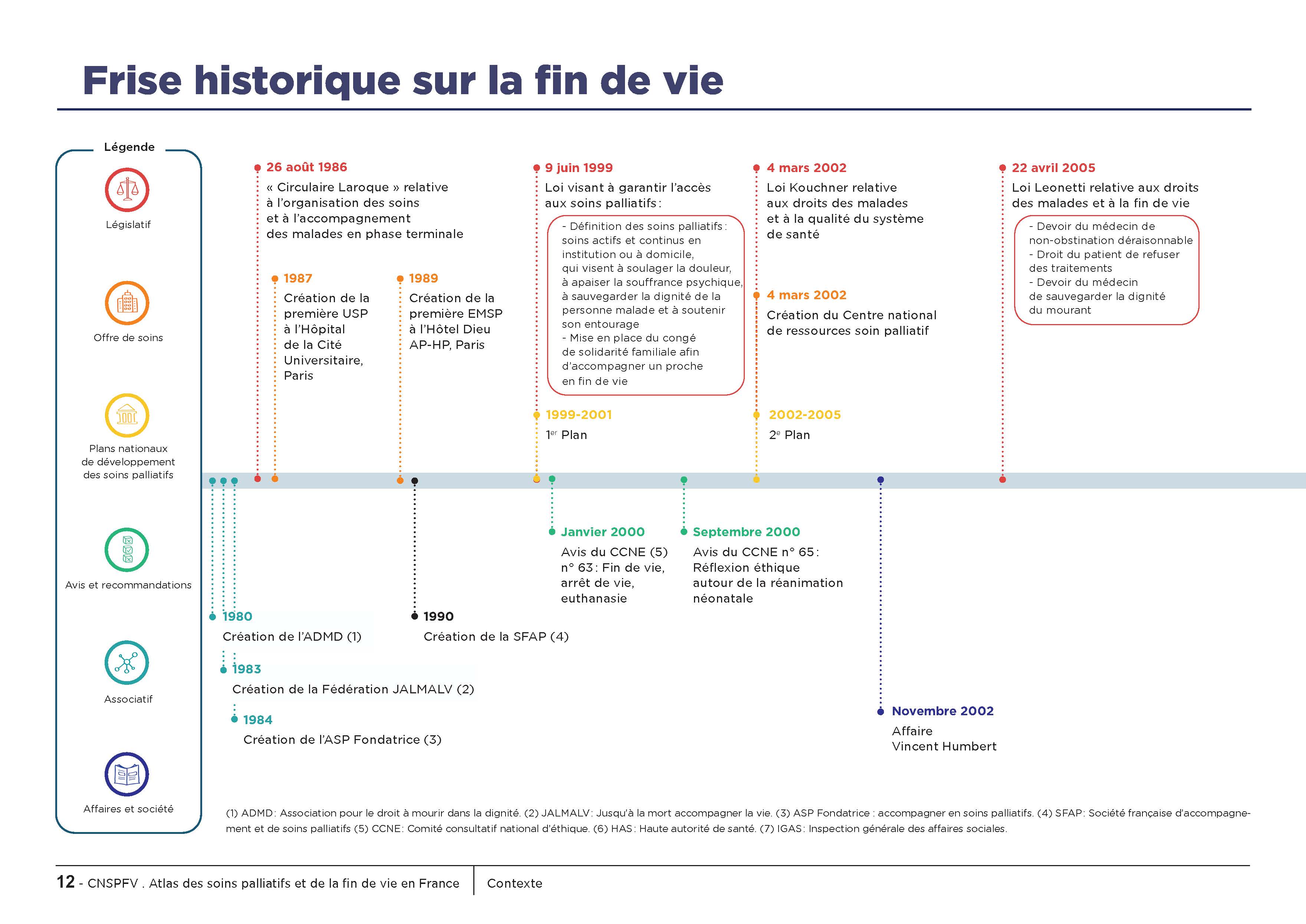
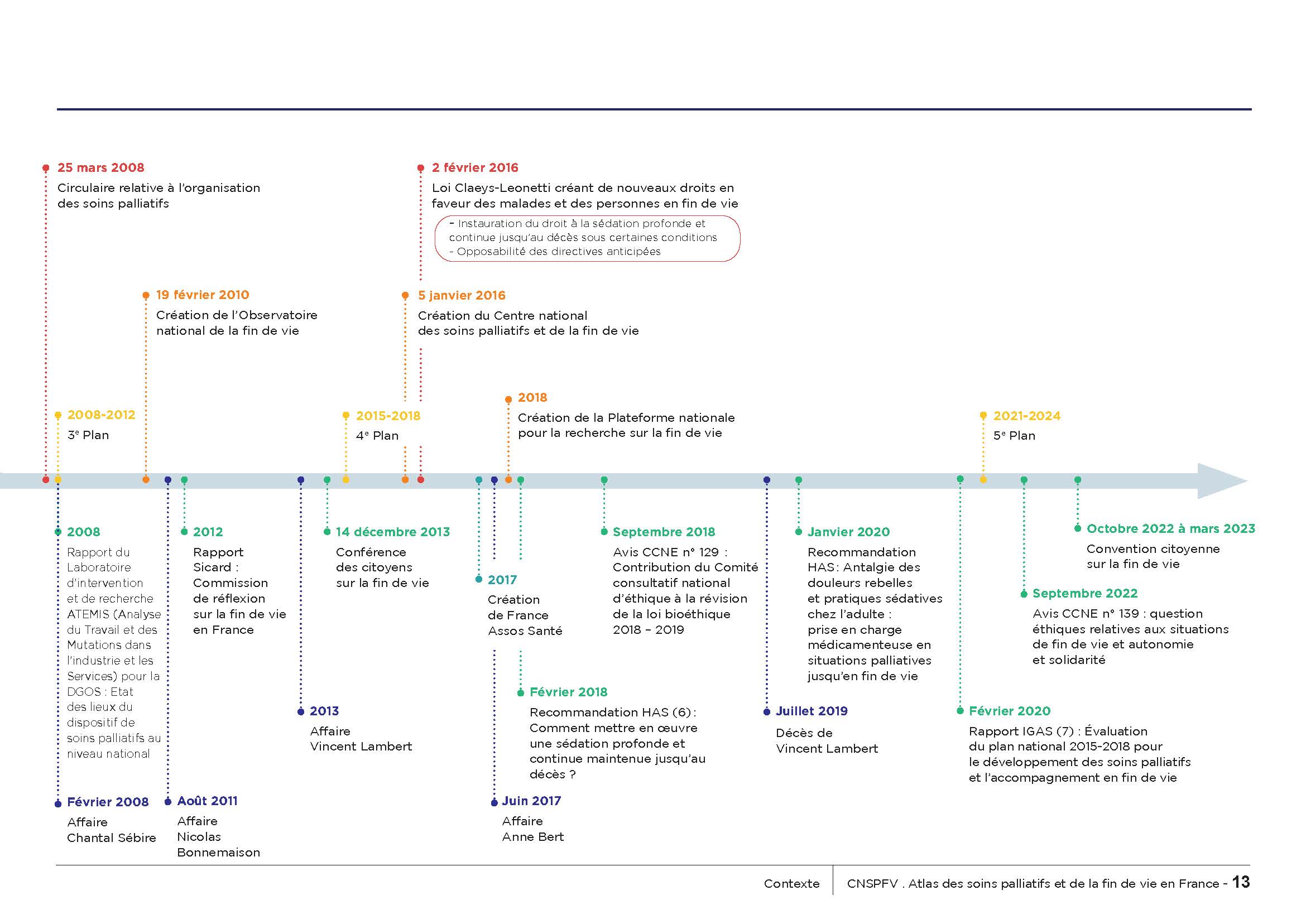
Chronological wind-up by the Centre national soins palliatifs et fin de vie (CNSPFV) in its Atlas 2023.
Missions
- Gather research forces in the end-of-life field.
- Create spaces for interdisciplinary exchange and optimize links between researchers and clinicians at regional, national and international levels.
- Make end-of-life research known and recognized, and interest learned societies, research institutes and political decision-makers in it.
- Proposestrategic research directions.
Actions
Constituting a research observatory
- Feeding a national directory of online researchers.
- Constitute a directory of research projects .
- Establish a cartography of research teams.
- Publish an annual panorama of research.
- Record theses in progress.
- Conduct annual surveys.
- Describe French scientific production.
Favor specific calls for projects
- Establish priority emerging research areas.
- Prepare research teams to respond to these calls for projects.
- Meet decision-makers, research institutes, associations and learned societies concerned with the end-of-life field.
Animinating the national scientific community
- Proposing colloquia (scientific days, doctoral days), webinars, seminars and workshops.
- Incite network members to collaborate at national and regional meeting days and via the dissemination of annonces.
- Conduct an active watch on scientific news (publications, events, calls for projects, calls for papers, appels à articles...) and disseminate this information.
- Communicate to value research work.
- Develop international relationships.
Activity reports