
Covid deaths in Migration
The MoCoMi project tackles the question of death among migrants during the Covid-19 pandemic from a variety of angles.
In the context of migration, the shadow of death is very often present, whether we are fleeing it, by leaving our country at war, or risking it, by crossing the sea on a makeshift boat. Migrants, most of whom were already in a vulnerable situation, have seen their situation worsened and made more complex by the pandemic. The security they had hoped for in France, a land of asylum with a reliable healthcare system, was not there in the end. The MoCoMi research project (for "Morts covid en migration") looks at the joint impacts of covid-19 and the migrant condition on these people's confrontation with death1.
Sponsored by the Institut convergences migrations (ICM)2, this two-year project mobilizes numerous researchers with complementary methods and disciplines: sociologists, anthropologists, historians, civilizationists, psychologists, philosophers, political scientists3. They carry out their work in border areas: in the Alps on the edge of Italy, in Strasbourg, in Le Havre, but also in the north of Paris. MOCOMI revolves around three main lines of research: firstly, the material and symbolic management of bodies, in a context where health protocols limit funeral practices around the body of the deceased; secondly, cultural and cultic representations relating to Covid-19 and its victims; and thirdly, the consequences for migrants' mental health of the loss of a loved one and bereavement in a pandemic context4.
Difficult bereavements
The work carried out in Seine Saint Denis and Le Havre highlights the disruption to funeral services and the resulting situations of complicated mourning. With the ban on visits and instructions for immediate entombment, many families were handed a sealed coffin on leaving hospital. Deprived of the opportunity to see their deceased, some of them found it very difficult to become truly aware of the death, and thus to overcome the trauma. For Muslim migrants, the ban on rituals such as funeral cleansing is a real source of distress. The pandemic has also revealed the extent of the shortage of Muslim plots in the cemeteries of many municipalities, some of them, not very conciliatory, refusing the reception of bodies according to the customs of Islam5.
The impossibility of repatriating the bodies to the country of origin generated a sense of failure among families who knew of this wish in the deceased. These felt they had not been able to accompany their loved ones properly in death. "Many families wonder about a possible exhumation of the mortal remains and their transfer to the country of origin once the borders are open again, but nobody wants to bury their loved ones twice. It's a real emotional ordeal... explains Linda Haapajarvi, sociologist. Will these situations change representations of the "good death" in migration? This is one of the research questions we hope to be able to answer in the long term."
Increased vulnerability
Students have experienced dramatic situations on learning of the illness or death of several loved ones left behind in their country of origin. Many have wondered about the possibility of returning, with no certainty of being able to return to study in France. Those who were suddenly deprived of their financial support also saw their precarious situation worsen. Indeed, Covid-19 has often altered migrants' material and legal living conditions. In the event of the death of the French spouse of a person in an irregular situation, for example, various forms of vulnerability have accumulated.
According to the populations surveyed, the perception of the epidemic danger varies: among some young people, we observe a distancing from death, but a huge amount of anxiety about the future. It's hard to worry about illness when managing daily life is already a struggle. For the Syrian refugees interviewed in the Strasbourg region, the death of Covid-19 is perceived as far less threatening than the war they fled. However, concern for their loved ones is still very much present, as they have to cope simultaneously with the conflict and the virus.
Has the pandemic changed the situation for people in the process of migrating? Did those who died during the journey suffer above all the consequences of their condition as migrants, or those of Covid-19? Has the epidemic reactivated the stereotype of foreigners as vectors of disease and death? How did border closures and confinements affect the situation of individuals facing deportation, or exacerbate the difficulties of those already settled? Has the health of the most disadvantaged been sacrificed?
All these questions are part of the many reflections addressed within the framework of MoCoMi. This project, which represents a wide diversity of studies, fields and populations, should produce a wealth of knowledge. To make the most of it, photographic reports, articles and a series of podcasts have been produced and made available on a dedicated website6. To be consulted without moderation.
- Research on the theme of death and migration is relatively recent. Initially confined to work on the burial sites of immigrants (these sites being perceived as a mark of integration), it has expanded over the last ten years or so to situations of violent death occurring during the journey (drownings in the Mediterranean, deaths in the Mexican desert).
- The ICM is a public research institute combining social sciences, humanities and health sciences, created as part of the Future Investment Program. It is funded by the French Ministry of Higher Education and Research. https://www.icmigrations.cnrs.fr/
- Nada Afiouni, civilizationist, Mathieu Grenet, historian, Linda Haapajärvi, sociologist, Carolina Kobelinsky, anthropologist, Françoise Lestage, anthropologist, Anaïk Pian, sociologist, Marie-Caroline Saglio-Yatzimirsky, anthropologist, Antoine Pécoud, sociologist and political scientist, Aïssatou Mbodj-Pouye, anthropologist.
- The last axis aims to produce recommendations for better support for these people.
- Municipalities are not obliged to provide a Muslim plot in their cemeteries, but with the interruption in the repatriation of bodies during the pandemic, the lack of dedicated locations became cruelly apparent.
- These reports and podcasts were produced by Anastasia Chauchard, a Masters student in Migrations at ICM.
For more information:
https://www.icmigrations.cnrs.fr/mocomi/
Contact :
Linda HAAPAJARVI
linda.haapajarvi@ehess.fr
View your profile in the Platform directory
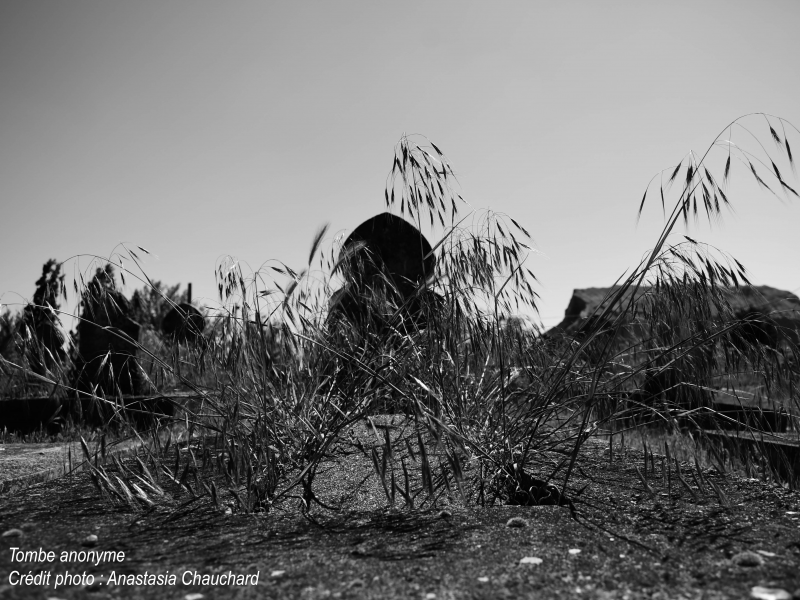
Photo credit: Anastasia Chauchard
Author : Delphine Gosset
Published 2/11/2021