

How can we develop the use of advance directives?
As part of their thesis, three young GPs have chosen to tackle the issue of advance directives, each from a different angle. Their investigations with patients, professionals and healthcare institutions have led to suggestions for increasing the use of this mechanism, which is still under-utilized.
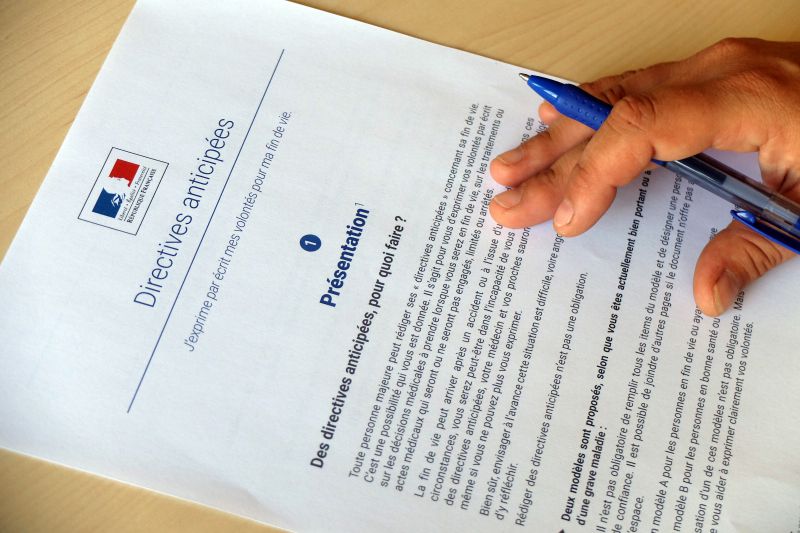
Advance directives1 correspond to a written statement in which a person indicates the medical treatments and procedures (resuscitation, respiratory assistance, artificial nutrition and hydration...) that he or she wishes, or not, to have carried out if one day he or she finds himself or herself in an end-of-life situation without being able to express his or her wishes. Poorly known to the general public, these directives are nevertheless very useful in guiding medical decision-making in critical situations. I was surprised to see how rare it was to find them in patients' files
, recounts Sarah Barbe, a general practitioner, at the end of her internship in the geriatrics department at Broca Hospital in Paris. A similar observation was made by her colleague Jacqueline Zhang, who practiced in EHPAD: "Often, the issue doesn't seem to have been addressed in the care project that is drawn up with the resident on arrival at the facility", she remarks. As the end of life is, in our society, a taboo issue, such a discussion can indeed prove emotionally complicated for patients and put caregivers in difficulty.
In order to analyze the obstacles to the use of this device and to consider avenues for improvement, three medical practice theses were launched under the direction of Matthieu Piccoli, a geriatrician at Broca Hospital. Jacqueline Zhang interviewed EHPAD residents, Sarah Barbe surveyed general practitioners and specialists throughout France using a computerized questionnaire, while Marie Baron looked at the opinions of representatives from the institutional world (health insurance funds, health networks, patient associations...) on 61 proposals for incentive measures focused mainly on information, training and remuneration.
Who should talk about it, and when?
"Among EHPAD residents, some are trusting and feel it's not their choice to make, while others are more autonomistic and want to be involved in the medical decision, notes Jacqueline Zhang. However, most have a positive view of this possibility". In the interviews she conducted, patients spoke of their fears: the fear of suffering, morally or psychologically, of being abandoned, of unreasonable obstinacy and the violation of dignity. "What they expect above all is more freedom of decision and shared reflection about their quality of life, health and care. Moreover, in their opinion, medical care in EHPAD does not sufficiently meet their needs", she points out. That's why she suggests broaching the subject of advance directives early on, and then discussing them regularly during a reassessment of the care project.
For their part, doctors are in favor of discussing advance directives, which also represents an opportunity to get to know their patients better. But to tackle this delicate subject, they would like to be trained and have dedicated information material. They insist that the attending physician should not be the only point of contact on this issue, and that their patients should also be informed in other ways. On the other hand, doctors are more divided on the idea of introducing specific remuneration for this procedure, which requires a special, longer consultation. However, according to Sarah Barbe, one problem remains: that of the applicability of these guidelines: "Often people ask for home care, to be more comfortable at home. But we don't always have the medical resources to do this. The issue of advance directives raises a wider problem: that of access to palliative care".
Quality of life
The representatives of healthcare institutions suggest that assistance in drawing up these directives should be included in the core missions of the attending physician, and that this document should be included in the software of doctors' surgeries, to make it more easily accessible. There was consensus on the need to train doctors: this should be provided from the very start of medical studies, with a theoretical basis, but also subsequently as part of joint continuing training with other healthcare professionals. Other well-received measures include information campaigns for professionals, particularly in EHPADs or associations, and even local debate meetings for the general public.
These three studies converge on a number of points, and in particular on the fact that the current document is too technical and formal. "The discussion would be much easier if it were approached from a quality-of-life perspective, talking instead about everyone's expectations, values and fears," concludes Jacqueline Zhang. All three also agree on the value of an approach involving not only the attending physician, but also other paramedical professionals (nurses, psychologists, care assistants, etc.) and the patient's family and friends. Lastly, in order to get everyone thinking about this issue, it is essential to use a variety of means to inform the general public about the benefits of this system.
- Advance directives were introduced in 2005 by the Leonetti law. In 2016, with the Loi Claeys leonetti, their initially consultative role became more binding.
Contacts:
Matthieu PICCOLI
Hospital practitioner
Responsable UF Équipe mobile de gériatrie
(geriatric mobile team)
AP-HP Centre Université de Paris
President of the
President of the association of young geriatricians
matthieu.piccoli@aphp.fr
Jacqueline ZHANG
Thesis (download): Expectations of elderly people living in EHPAD du 95 faced with the end of life: do advance directives have their place?
zhangjacqueline1@gmail.com
Sarah BARBE
Thesis title: Le médecin traitant face aux directives anticipées : un dispositif incitatif ferait-il modifier la pratique?
sarah.barbe89@gmail.com
Marie BARON
Thesis (download): Improving the rate of writing advance directives: Expert consensus on a support scheme for the attending physician combining training, information and financial reward
marie.baron19@gmail.com
Published July 2, 2020
Author : Delphine Gosset