

2023 International Francophone Scientific Day
Access to palliative and end-of-life care for all:
A matter of equity, diversity and inclusion
Online study day on February 2, 2023 from 8am to 12pm, Quebec time and from 2pm to 6pm, French time.
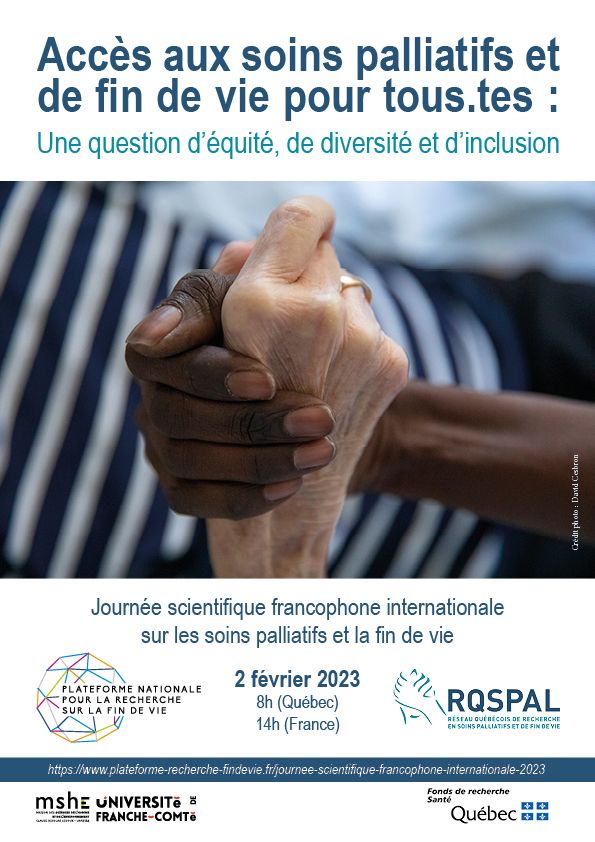
A major societal movement is being orchestrated worldwide with regard to equity, diversity and inclusion (EDI). The healthcare field is no exception. Having suffered in its early days from a form of opposition, unfounded, to curative care, palliative and end-of-life care (EOLC) is unfortunately not accessible to all.
At first glance, when we think of this care, we often imagine patients with advanced cancer. However, a wide range of pathologies can benefit from them: Alzheimer's disease or multiple sclerosis, for example. Access to these PEOLC is more difficult for vulnerable, remote and marginalized populations, such as the homeless or itinerant, people from immigrant backgrounds or from cultures different from those of the care environments, indigenous populations, members of LGBTQ2+ communities, the elderly, children with potentially fatal chronic illnesses, people far from major urban centers, etc. Services are poorly adapted to these realities, and healthcare professionals and caregivers gravitating around these patients are not adequately equipped to deal with these situations.
On these subjects, the scientific literature is rather sparse and inconclusive. A host of questions that should be explored further remain. These include: how do palliative care settings coordinate and adapt to this reality? What can we learn from the literature, and what avenues of reflection can we draw from this knowledge? Is access to quality palliative care for all our populations utopian? What are the impacts on healthcare professionals, caregivers and family caregivers?
This emerging movement fascinates and generates a multitude of unexplored fields of study for our researchers. This virtual meeting will be an opportunity to discuss the issues surrounding the EDI criteria in PEOLC
'Kusa Ikivi ': Death as an achievement in the Rwandan socio-cultural context
Christian NTIZIMIRA
Center Africain de Recherche sur la Fin de Vie, Rwanda
The perception of death in Rwanda has changed from pre-colonial to post-colonial times. Previously considered a natural phenomenon and an achievement under certain social conditions, death became a source of fear after the introduction of modern religion. Today, patients suffering from life-limiting illnesses suffer from a lack of identity in their care. Family members' contributions at the end of life are crucial in advance of care planning.
Current models of advance care planning and end-of-life care decision-making are developed from Euro-American clinical and cultural experience. It is important to create a locally based model based on Ubuntu's Afro-centric, relevant and community-centered philosophy for end-of-life care that ensures the dignity and well-being of patients, family members and is consistent with available resources, local care priorities and Rwandan values.
Speaker

Dr. Christian Ntizimira is the founder and executive director of the African Center for Research on End-of-Life Care (ACREOL), a non-profit organization aiming to bring equality and socio-cultural equity through "the Ubuntu philosophy in end-of-life care" to Africa. He is a graduate of Harvard Medical School's Fulbright Program, Department of Global Health and Social Medicine. Dr. Ntizimira has pioneered the integration of palliative and end-of-life care into health services for Rwandan cancer patients and in community settings. He has advised several governments on national palliative care policy, including Burundi, Rwanda and Senegal, on access to palliative care services.
Issues related to the nurse's care of people living with amyotrophic lateral sclerosis at the end of life
Stéphanie DANEAU
Université du Québec à Trois-Rivières, Quebec
Inequality in access to palliative and end-of-life care (PEOLC) between oncology and non-oncology clientele is well described in the literature. Amyotrophic lateral sclerosis (ALS) is one of the non-oncological diseases that suffer from inequitable access to palliative and end-of-life care for sufferers. This study therefore focused on nurses' experiences in caring for this population. The aim of this study is to explore issues related to nurses' care of people living with ALS at the end of life. Guided by the perception of nursing competence in palliative care proposed by Desbiens (2011), the study used a qualitative multiple-case study design proposed by Stake (2006). Cases were delimited by the nurses' work environment, as this has a significant impact on the organization of care. A total of 9 homecare nurses, 8 hospital nurses and 7 hospice nurses participated in the study through semi-structured individual interviews, for a total of 24 participants. The data were analyzed using the method proposed by Miles, Huberman & Saldana (2020).
The results reveal the issues surrounding the scope of care to be provided, the assessment and support of people with verbal communication difficulties, and the sense of powerlessness often felt. The needs identified by nurses and their recommendations will also be presented. The training, organization and resources allocated to the care of people living with ALS at the end of life are clearly inadequate and must be reviewed. Currently, access to quality care for this population is far from assured.
Speaker

Stéphanie DANEAU, RN, PhD, is Assistant Professor in the Department of Nursing at the Université du Québec à Trois-Rivières, Canada. A regular member of RQSPAL, her work focuses on the accessibility and quality of palliative and end-of-life care, particularly in the context of amyotrophic lateral sclerosis.
The invisibles of end-of-life law
Aline CHEYNET DE BEAUPRE
CERCRID Saint Etienne UMR 5137, University of Orléans, France
French law separately knows two major concerns: on the one hand, that relating to equity, non-discrimination or inclusion (EDI), and on the other, palliative and end-of-life care law (SPFV). Legally, however, the two themes do not seem to intersect. This is how the invisibles of end-of-life law emerge. And yet, three major categories of population can be identified: LGBTQ2+ people, people with insufficient mental faculties and homeless people. These are all vulnerable, remote or marginalized populations.
The study will explore possible legal responses to shortcomings, obstacles and risks, considering patients, their families and caregivers. An analysis of the legal literature (regulations providing for, ignoring or preventing EDI in SPFV...) aims to identify the main pitfalls linked to uninformed consent, unequal treatment, non-access or positive discrimination in particular. France is lagging behind in regulations that ignore atypical populations (lack of concern, communication, information, care, etc.). At the same time, end-of-life litigation is developing in Europe (euthanasia of a depressed mother in Belgium, cessation of treatment for infants in England, drafting of advance directives in France, etc.). The main difficulties relate to the consent of minors and the intellectually impaired, to the need for personalized approaches that avoid positive discrimination, and to a genuine policy for the development of palliative care. In this reading, would the French project for active assistance in dying risk further precarity for vulnerable populations, or would it take these issues into account?
Speaker
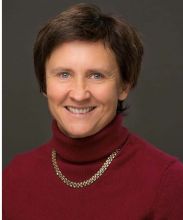
Aline CHEYNET DE BEAUPRE is Professor of Private Law at the University of Orléans (France) and a member of the Centre de Recherches Critiques sur le Droit (CERCRID) in Saint-Etienne (UMR 5137; France). His research work focuses mainly on two main areas: people and ethics; his publications and speeches specialize in bioethics law, family law, death, euthanasia, end-of-life and palliative care.
Augustin BOULANGER, ICES lecturer in private law, member of CRICES.
Dying with dignity: end-of-life experiences of migrants and non-migrants in Montreal (pre-pandemic)
Sylvie FORTIN
Department of Anthropology, Université de Montréal, Québec
In Quebec, a law enacted in 2015 confirms the right of any person at the end of life to receive care appropriate to their needs regardless of their illness, age, region of residence or place of care. Wishing to better define this "dying with dignity", we examine the end-of-life experiences of more than a hundred Montrealers of origin or adoption, from the youngest to the oldest, migrant and non-migrant women who died in Montreal (Canada) in the years preceding the COVID-19 pandemic. Based on interviews with Aproches, we describe the care received at the end of life and discuss the elements that promote or hinder access to palliative care in a context of diversity. The data presented reveal unequal access to palliative care at the intersection of several phenomena, including the type of illness, the patient's age, the uncertainty of prognosis and the patient's minority status. Youth and cancer are undeniably carriers of a care offer (curative and palliative) whereas those who do not benefit from palliative care have in common to be minorities in the local society and to suffer from diseases with ambiguous prognosis. "Dying with dignity" goes beyond the question of access or otherwise to palliative care to embrace the link, the care relationship, whatever the place of end of life.
Speaker
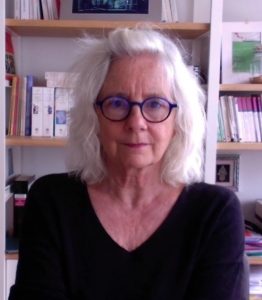
Sylvie Fortin is a full professor in the Department of Anthropology at the Université de Montréal and is attached to the Faculty of Medicine (Department of Pediatrics). She is a researcher at the Institut universitaire SHERPA (CIUSSS Centre-Ouest-de-l'Île-de-Montréal), at the Centre de recherche du CHU Sainte-Justine and a member of the InterAction team. After conducting several research projects on social, cultural, ethnic and religious diversity and the actualization of this pluralism within hospital clinics here and elsewhere, her recent work questions the moral and normative issues staged during therapeutic decisions that lead from curative to palliative care at different stages of the life cycle.