
The complexity of suffering in palliative and end-of-life care
The contents of the 6th International Francophone Scientific Day co-organized on February 5, 2026 by the Plateforme nationale pour la recherche sur la fin de vie and the Réseau québécois de recherche en soins palliatifs et de fin de vie (RQSPAL) are available online.
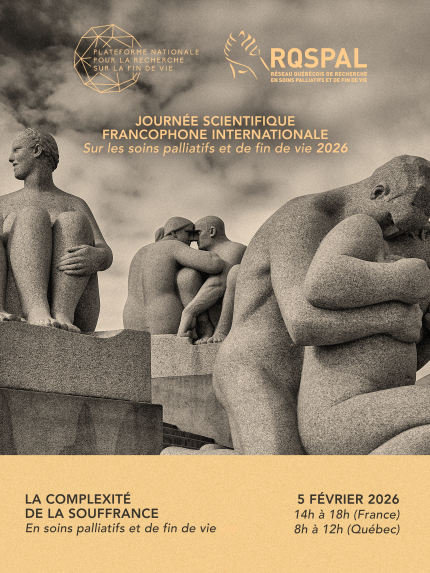
At a time when palliative and end-of-life care (EOLC) is going through profound medical, social and ethical changes, suffering remains a central issue, but one that is still insufficiently explored in all its complexity. Long focused on physical pain, the term suffering is gradually opening up to a broader understanding: psychological, social, moral, spiritual and existential, cultural, anticipated, linked to the trajectories of illness or end-of-life and the lived realities of people, their loved ones and caregivers. Studies and debates around palliative care and aid in dying (medical aid in dying in Quebec) have brought to light the importance and specificity of suffering in PEOLC situations.
In this context, research has a fundamental role to play: not only to produce knowledge, but also to question its own methods, its blind spots, and the forms of collaboration it establishes.
This scientific day aimed to foster disciplinary cross-fertilization, to bring researchers∙ses, practitioners, carers, cared-for people and loved ones into dialogue, and to value sensitive, situated, collaborative approaches. This year's event attracted more than 500 registrants (including more than 300 online for the event): researchers, practitioners, caregivers and loved ones from all over the French-speaking world.
Five researchers took turns to reflect on these issues at the fifth edition of this international francophone scientific day:
Chloé PROD'HOMME addressed the subject of suffering and comfort at the end of life, through ethical issues and the uses of neurophysiological assessment. Alizée LAJEUNESSE dealt with conflicting end-of-life issues in residential and long-term care centers (CHSLD), and more specifically with divergent suffering and caregiver moralities. Sébastien SIMARD addressed the moments when "suffering goes under the radar" by presenting how to assess psychological distress and needs in oncology. Maya CORMAN explored the concept of total pain in contemporary palliative oncology care, through a qualitative study of patient resources. Finally, Alexandra BEAUDIN presented a qualitative study of refusals of medical aid in dying: between suffering, despair and hope.
To find speaker profiles, paper summaries and videos:
Check out the dedicated page on our website
The videos are also available on our youtube channel: