

Dying in a monastery
How do today's contemplative communities deal with the end of life and death of their members? Two sociologists carried out an ethnographic study in several monasteries.
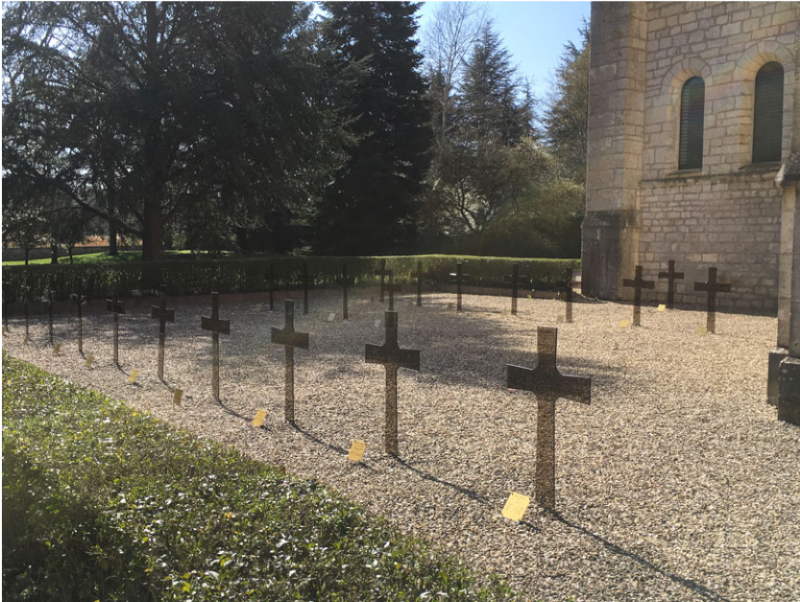
Annick Anchisi and Laurent Amiotte-Suchet are sociologists, one a specialist in old age, the other in religions. They are collaborating on an ethnographic1 research project focusing on sixteen different monastic communities located in French-speaking Switzerland and Burgundy-Franche-Comté. Between 2019 and 2020, these two researchers made several2 immersion visits to these monasteries, carrying out observations and interviews.
The rhythm of contemplative life, centered on study and prayer, is not all restful. Daily life is organized between work and services (which sometimes take place at night), leaving very little room for free time. In most communities, silence is the rule, except when discussing the organization of collective life, commenting on the Rule3 or sharing a short moment of recreation. There is no statutory retirement, even for the oldest members, who continue to perform tasks useful to the community and adapted to their state of health.
Religious join these communities at the end of a long period of formation by taking solemn vows. In this way, they commit themselves to living within a given monastery, working there, participating in collective life, and obeying.
In this context, the researchers found that everything is done to keep the individual at the center of community life. Those in the infirmary, for example, are fetched to attend services. In fact, the rhythm of the monastery, even if it is trying for the elderly, also has a structuring dimension. We can assume that it helps to curb the symptoms of certain cognitive disorders
, stresses Annick Anchisi.
Well-integrated palliative norms
We no longer hear talk of pain-related redemption: there's no need to suffer to reach the gates of paradise, and the use of morphinics is accepted
, adds the researcher. Today's palliative standards have gone beyond the walls of the monastery. We seek to respond to symptoms (pain, dyspnea...) with appropriate care, either through community members trained in care, or by bringing in outside professionals. It cannot be said that these monks and nuns are less well cared for than in EHPAD or an institution
, note the sociologists.
In an environment where everyone has a role to play, the role of the nursing brother or sister is above all one of benevolent accompaniment: it involves reassurance, through an attentive presence, night and day, and acting as an intermediary with liberal doctors or nurses, whom they do not hesitate to call on (which is also a way of preserving everyone's privacy).
Some monasteries have fitted out their infirmaries to transform and medicalize part of their premises3. If necessary, they can call on nursing staff to intervene with elderly members without disrupting contemplative life. In this way, those who have become dependent can remain on the premises, close to their loved ones, in the monastic rhythm.
The vow of stability, a promise to spend one's life in the monastery, is very important. Monks and nuns are keen to die surrounded by their brothers or sisters, which is why placement in specialized institutions is avoided as far as possible. Sometimes, however, the symptoms become too difficult to control, or the person, now demented, disrupts community life by wandering about or breaking the great silence established during the night. In such cases, the decision to place the person in outpatient care is taken only after difficult collective debate, as this type of placement has never been practised or even envisaged in the past. But, in any case, the sibling will be sought out at the moment of agony, or just after death, to perform the age-old rituals.
A scenography of permanence
The community has perfect mastery of accompanying the dying and funeral rituals. Everything is framed, everyone knows their place, their role, the words to be spoken. These highly codified traditional practices, which are perpetuated year after year, give a sense of permanence that makes it possible to cope with death. However, these a priori immutable rites have sometimes had to be rearranged. In some convents, for example, cremation has been accepted because, in particular, it was becoming too difficult for elderly people to dig a grave without outside intervention.
When people die, the whole community gathers together. Afterwards, we try to keep the memory of the deceased alive for a long time, through little things like placing his photograph in his place at the table. The idea of individuals as one is maintained. However, while end-of-life and death are dealt with collectively, there is, strictly speaking, no warm intimacy between members of the same community. Although religious men and women like to describe themselves as a spiritual family, their bonds are not those of a traditional family. There's no crying at funerals. The members of these communities know that at some point, one of their own will die, and the ritual has been thought out for a long time.
- This research is funded for 4 years by the Swiss National Science Foundation (SNSF): "Living and aging apart from the world. Stratégies de préservation des ordres monastiques" (SNSF research, Division I, project no. 179047).
- These stays were carried out over periods of 7 to 10 days, with subsequent 3 or 4-day returns to the field.
- By "the Rule" we mean the community's rule of life, a written document that rules on the common rules of monks and nuns. Inspired by more ancient rules (the rule of Saint Benoit, Saint Augustine...) communities draw up rules for common life at the time of their foundation, and can evolve them over time.
- This was observed in a previous study of apostolic congregations.
Contacts:
Annick ANCHISI
Sociologist, full professor
Haute école de santé Vaud (HESAV - HES-SO)
Lausanne
annick.anchisi@hesav.ch
Laurent AMIOTTE-SUCHET
Sociologist, research fellow
Haute école de santé Vaud (HESAV - HES-SO)
Lausanne
laurent.amiotte-suchet@hesav.ch
For more information
Website for this research:
https://vieillirmonastere.hesav.ch/
Presentation of this work at our 2020-2021 scientific seminar:
See the presentation of this work at our 2020-2021 scientific seminar
Bibliographical references:
- Amiotte-Suchet (L.), Anchisi (A.) - "Quand on rentrait, c'était pour la vie", Vieillesse et dépendance dans les communautés contemplatives, Archives de sciences sociales des religions, 2020, pp. 165-187.
- Anchisi (A.), Amiotte-Suchet (L.) - "Se lever pour Vigiles. Tenir le coup pour vieillir et mourir au monastère ", in. Gérontologie et Société, Finir sa vie, hâter la mort au grand âge, Balard & al. dir., 2020, pp. 63-75.
Published June 11, 2021
Author : Delphine Gosset
Photo credit: Laurent Amiotte-Suchet