
The "La vie, la mort... On en parle?" project mobilizes research data for the general public
The internet portal launched by SFAP at the beginning of February provides parents and educators with resources to help them talk to children and teenagers about end-of-life issues, death and bereavement. Numerous researchers have contributed to the development of these resources.
While the issues of serious illness, end-of-life and death regularly intrude on school grounds, teachers and parents alike often find themselves caught off guard when it comes to addressing these sensitive subjects with children and teenagers. To help them, the Société française d'accompagnement et de soins palliatifs (SFAP) has set up a web portal entitled "Life, death... On en parle?", which offers them a wide variety of documentary resources.
As a learned society, SFAP was keen to provide this portal with scientifically rigorous and legitimate content, as young people are a potentially vulnerable audience and certain situations - young people in palliative care at school, young orphans, young caregivers - are complex to support
, explains Nicolas El Haïk-Wagner, project manager. Researchers have been called upon to produce content for the site. However, as studies on children and adolescents confronted with end-of-life situations, death and bereavement are still rare in France, identifying French-speaking scientists who have carried out work on this theme represented a real challenge1.
References for understanding and paths to support
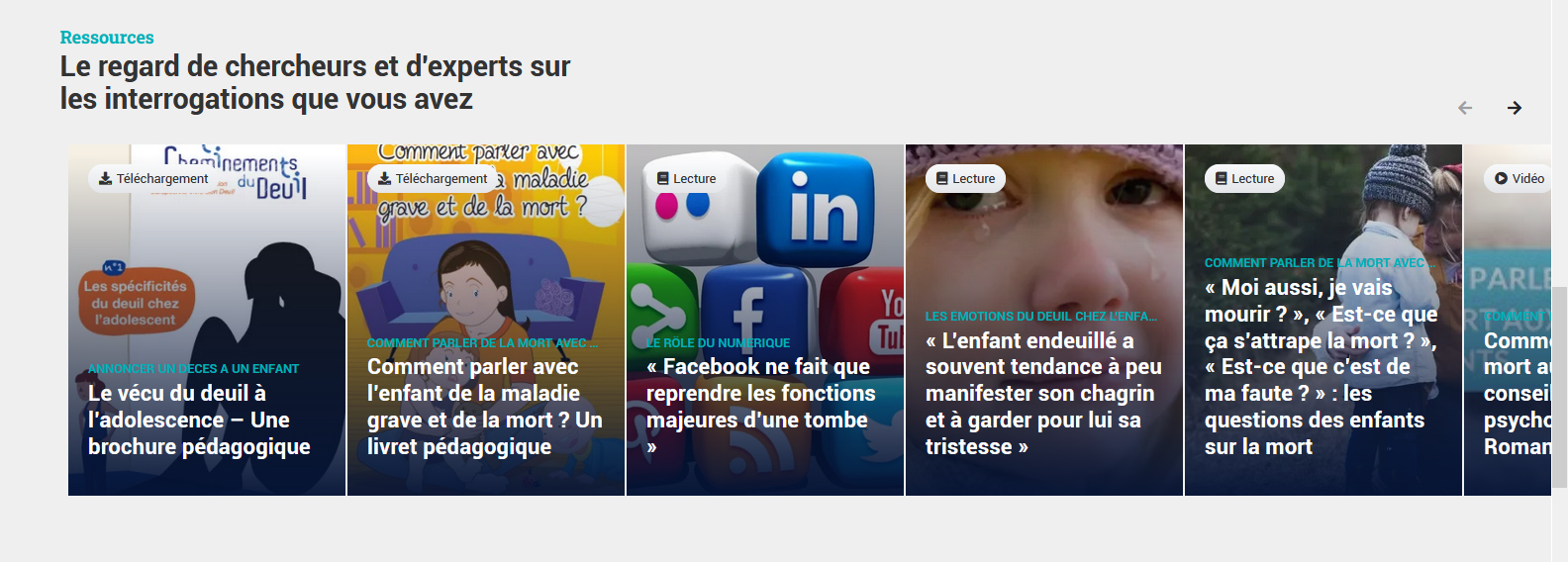
Thanks to the contributions of these researchers, the portal covers a wide variety of subjects: manifestations of grief in children, the impact of grief on learning, grief in young people with a migratory background, the role of digital technology or social networks, representations of death in video games... Other articles have been written by professionals (psychologists, doctors, nurses, art therapists...). In all, some one hundred documents were produced by nearly 80 different experts, with the shared aim of providing users with "reference points for understanding and paths for support". All of this was complemented by pre-existing documentary resources (brochures, videos) published by other structures or associations.
This work was carried out with a constant concern for accessibility. Real thought was given not only to ensuring that the texts were concise and understandable, but also that the graphic aspects and illustration allowed for optimum visual appropriation of the content
, recounts Nicolas El Haïk-Wagner. In the end, this portal is a fine example of the transformation of research data into useful resources for the general public.
The "La vie, la mort, on en parle" project also plans to develop its own scientific output. An initial study looking at how teachers experience schooling in an ordinary environment for a child or teenager undergoing palliative care has just begun in partnership with the Laboratoire psychopathologie et processus de santé (LPSS) at the University of Paris. Others will follow, with the prospect of better management of these painful situations.
- The Platform's directory of researchers was used for this census.
Contact:
Nicolas El Haïk Wagner
Head of the "Life, death... Shall we talk about it?"
project
SFAP "Young Generations" working group
nicolas.ehw@gmail.com
jeunes-generations@sfap.org
lavielamortonenparle.fr
Published April 20, 2021
Author : Delphine Gosset