

Research panorama 2022
The data presented below was extracted in June 2022. We have improved our classification systems for a more accurate overview.
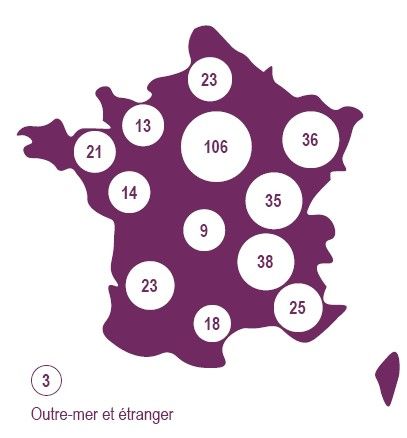
In our directory, 366 people declare that they work on themes related to the end of life.
Women are more represented than men (63% versus 37%).
73% of these researchers are affiliated to a research unit or clinical research structure, while 130 directory members conduct research while practicing in hospital or medical departments.
| Number of research units | Number of researchers |
|---|---|
| 143 research units (EA, UR, UMR, UPR, UAR...) | 245 |
| 8 clinical research structures (CIC, URC, UIC) | 22 |
Disciplines
Our classification, built on the basis of researcher declarations, includes 56 specialties.
54% belong to the medical, paramedical and life sciences.
46% belong to the humanities and social sciences.
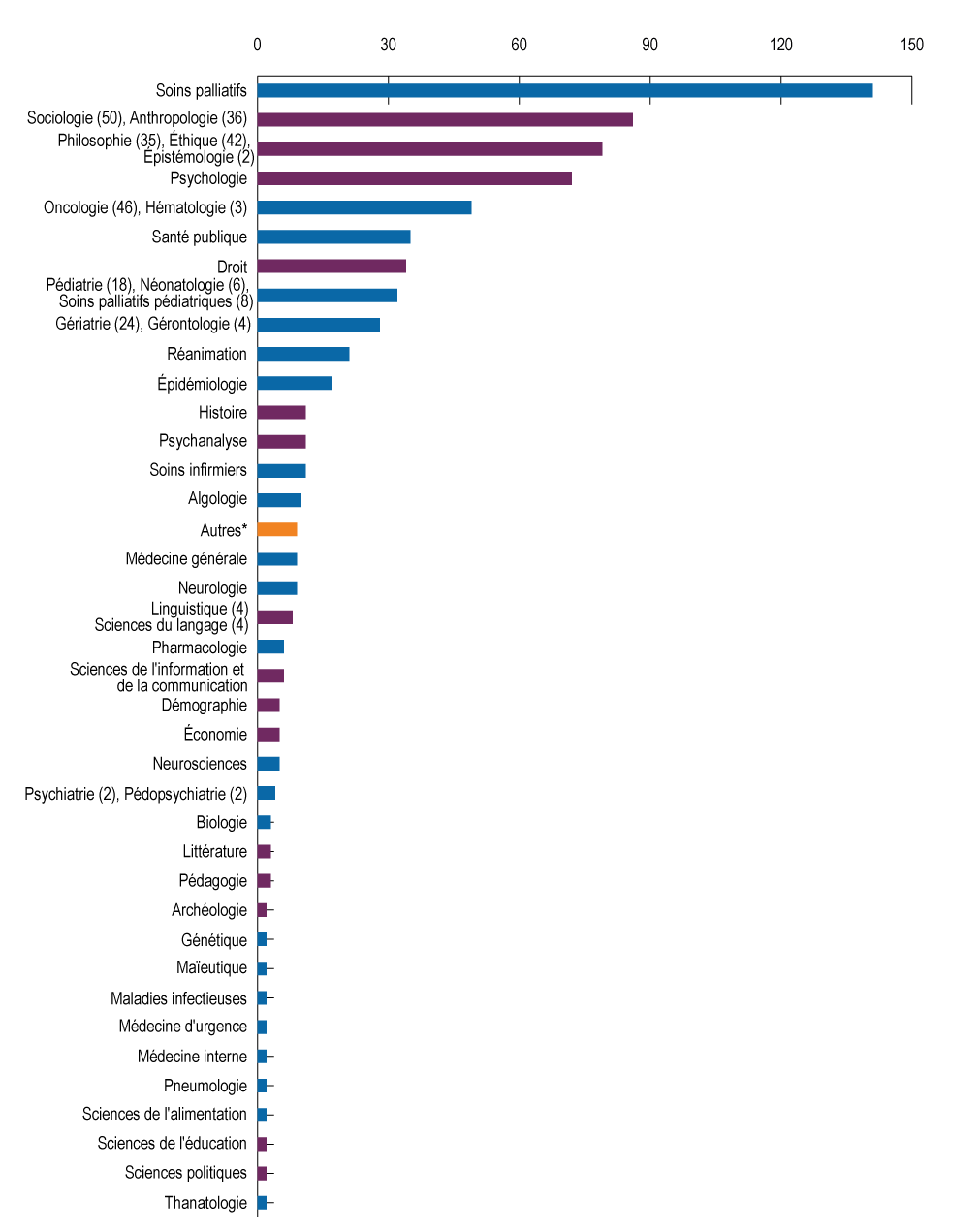
In the chart above, the "other" category corresponds to: arts, cardiology, hyperbaric medicine, computer science, management science, psychomotricity, image semiotics, clinical pharmacy, design.
Research topics
| End-of-life locations: home (40), institutional (47) | 87 |
| Experiences and perceptions | 76 |
| Ethics, bioethics | 76 |
| Patient support | 66 |
| Decision-making processes | 65 |
| Anticipation, advance directives | 63 |
| Support for relatives and caregivers | 61 |
| Sedation | 53 |
| Social and cultural representations | 52 |
| Mourning | 47 |
| Practice assessment, tools and scales | 43 |
| Death wish, euthanasia, assisted suicide | 42 |
| Pain management | 41 |
| Law and legislation | 38 |
| Psychic and spiritual suffering | 36 |
| Quality of life | 34 |
| Care path | 33 |
| Early palliative care | 32 |
| Staff training, pedagogy | 31 |
| Drugs, therapeutics and medical devices | 31 |
| Symptom assessment and management | 29 |
| Communication | 26 |
| Care organization | 25 |
| History of palliative care (9), history of death (15) | 24 |
| Interprofessional collaborations | 21 |
| Spirituality and religion | 17 |
| Food, artificial nutrition | 16 |
| Organ donation and procurement | 13 |
| Autonomy and people at the end of life | 12 |
| Limitation and cessation of treatment | 10 |
| Philosophy of death | 10 |
| Health policies | 10 |
| Pandemic - Covid-19 | 8 |
| Alternative and complementary medicine | 7 |
| Agonie | 6 |
| Therapeutic education | 6 |
| Depressive disorders | 5 |
| Biology of aging | 4 |
| Funeral practices, post-mortem care | 4 |
| Economic issues | 4 |
Populations and pathologies
| Palliative care patients | 97 |
| Cancer | 88 |
| Aging and the elderly | 72 |
| Health care professionals | 61 |
| Vulnerable people | 42 |
| Neurodegenerative diseases | 36 |
| Resuscitation | 35 |
| Loved ones and caregivers | 32 |
| Pediatrics | 28 |
| People with disabilities | 20 |
| Psychiatric illnesses | 19 |
| Teens and young adults | 15 |
| Organ failure: nephrology (4), cardiology (7), pulmonology (4) | 15 |
| Primary care and general medicine | 11 |
| Neonatology | 10 |
| Parents of life-threatening children | 10 |
| Genetic diseases | 8 |
| Funeral professionals | 8 |
| Volunteers | 7 |
| Populations of the past | 5 |
| Emergency medicine | 4 |
| Migrants | 4 |
| Victims of crime | 4 |
| Others: gynecology (1), obesity (1) | 2 |
| Internal medicine | 2 |
| Orphans | 2 |
| Patient partners | 2 |
Methodologies
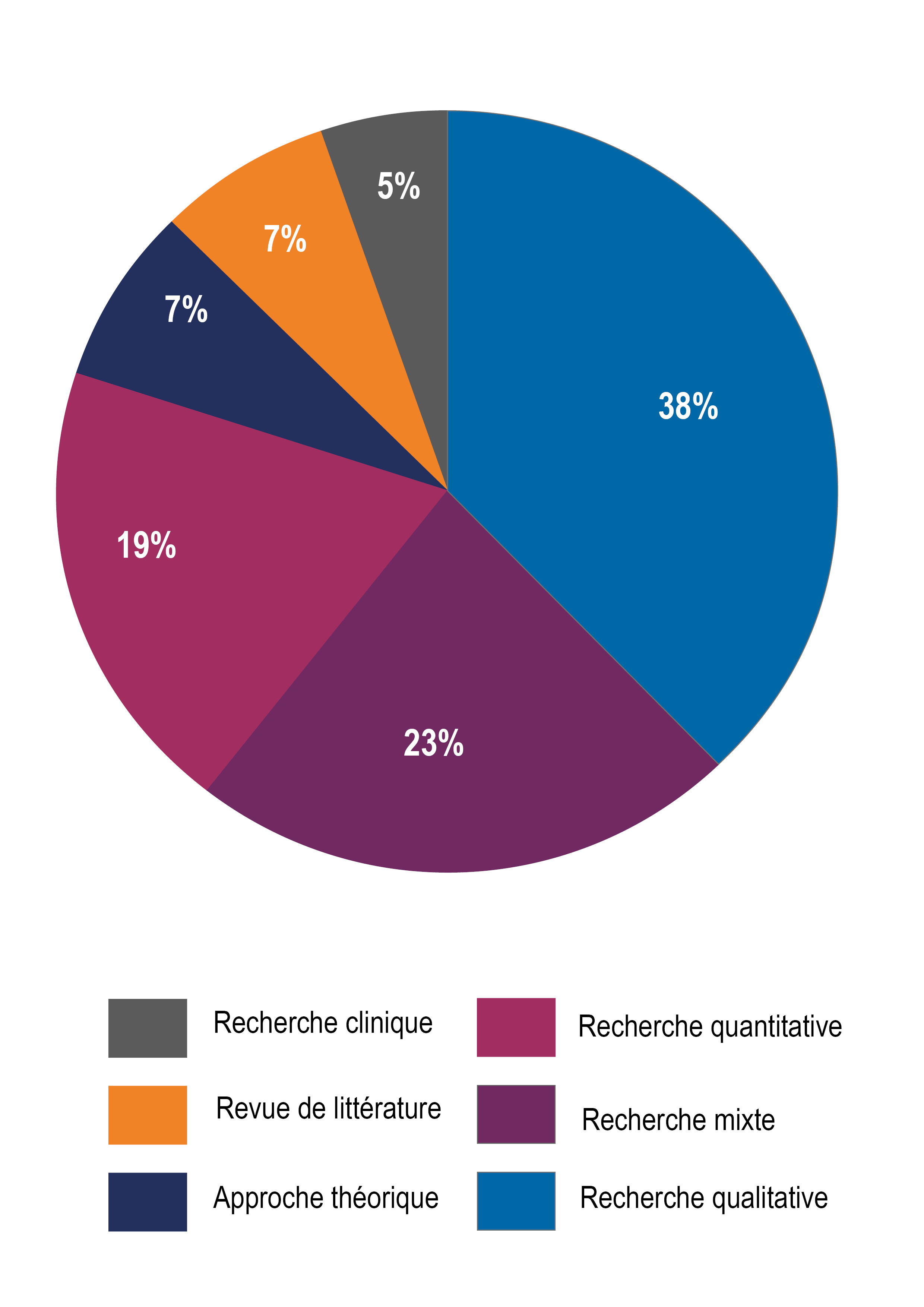
A single person may have reported using several methods in their research work.
The theses
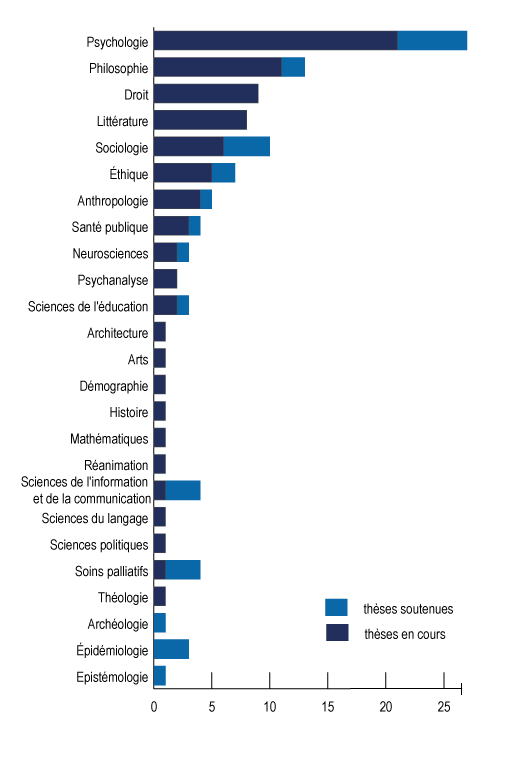
Since 2019 we have been listing theses on topics related to end-of-life and palliative care (source theses.fr).
However, this census is not exhaustive and does not take into consideration theses for practice in medicine or pharmacy.
In 2021, there were18 thesis registrations,83 theses in progress and 27 theses defended.
Disciplines
Thematics
| Thematics | Current | Supported |
| Experiences and perceptions | 17 | 7 |
| Mourning | 14 | 2 |
| Ethics, bioethics | 11 | 3 |
| Funeral practices, post-mortem care | 10 | 3 |
| Law and legislation | 9 | 0 |
| Social and cultural representations | 9 | 3 |
| Death wish, euthanasia, assisted suicide | 7 | 0 |
| Patient support | 6 | 2 |
| Interprofessional collaborations | 5 | 1 |
| Autonomy for people at the end of life | 4 | 1 |
| Support for relatives and caregivers | 3 | 0 |
| Communication | 3 | 2 |
| End-of-life places (home or facility) | 5 | 3 |
| Predictive markers of death, prognostic factors | 3 | 0 |
| Philosophy of death | 3 | 1 |
| Sedation | 3 | 1 |
| Organization of care | 2 | 3 |
| Decision-making processes | 2 | 3 |
| Psychic and spiritual suffering | 2 | 0 |
| Anticipation, advance directives | 1 | 3 |
| Organ donation and procurement | 1 | 1 |
| Evaluation of professional practices, devices, tools and scales | 1 | 0 |
| Symptom assessment and management | 1 | 1 |
| Professional training, pedagogy | 1 | 0 |
| Neurobiological mechanisms of death | 1 | 0 |
| Care path | 1 | 1 |
| Health policies | 1 | 3 |
| Pain management | 1 | 1 |
| Early palliative care | 1 | 1 |
| Spirituality and religion | 1 | 0 |
| Limiting and stopping treatment | 0 | 3 |
Download brochures
Edition 2022
Download the 2022 panorama French version
Updated on 20/06/2022
Data extraction and processing : Sophie Aupet