

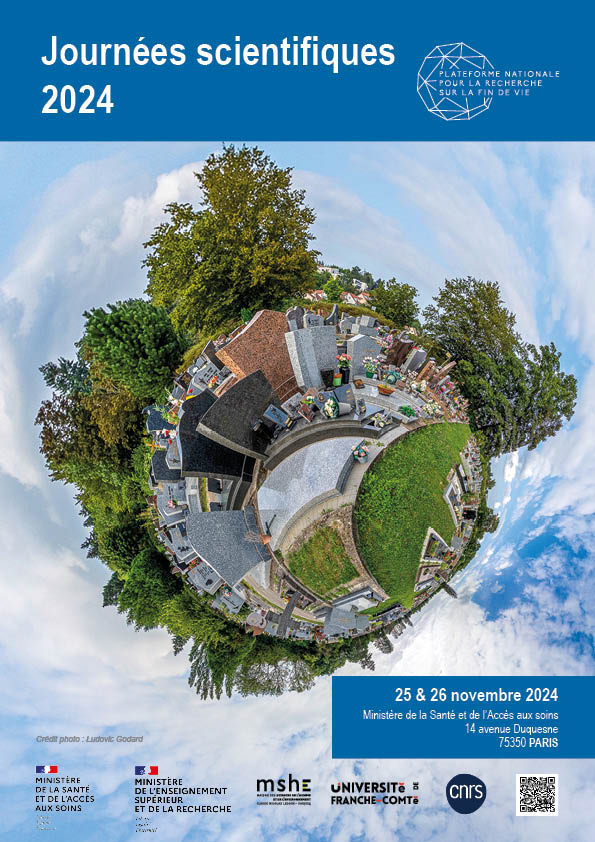
Scientific Day 2024
The French National Platform for End-of-Life Research organized the sixth edition of its Scientific Day on Tuesday, November 26, 2024, at the premises of the Ministry of Health and Access to Care.
This day also marked the official launch of the Interdisciplinary End-of-Life Research Program. The event was structured around the program’s three main axes, with presentations addressing the themes of pain and suffering, data, and care pathways
Launch forum
Launch of the interdisciplinary End-of-Life research program
Franck MOUTHON, executive director of Inserm's health research program agency.
Marie GAILLE, director of the Institute of Human and Social Sciences (INSHS) at CNRS.
Benoit LAVALLART, chargé de mission at the MESR's Direction générale pour la Recherche et l'Innovation.
Régis AUBRY, pilot of the Interdisciplinary End-of-Life Research Program, founder in 2018 of the French National Platform for Research on the End of Life.
Sarah CARVALLO, co-chair of the French National Platform for Research on End of Life, pilot of the Interdisciplinary End-of-Life Research Program.
Valérie FROMENTIN, head of the Human and Social Sciences department at ANR.
Arnaud DE GUERRA, Deputy Director of INSERM's Public Health Institute.
Suffering
Classification, physiology and pathophysiology of pain
Didier BOUHASSIRA, neurologist, pain specialist, director of the Inserm U987 Pain Physiopathology and Clinical Pharmacology Unit, Pain Evaluation and Treatment Center, Ambroise Paré Hospital, Boulogne-Billancourt.
Data
Using the SNDS to identify End-of-Life care
Philippe TUPPIN, medical epidemiologist, Strategy and Statistics Department at Assurance maladie.
Care pathways, life pathways
Non-drug interventions: from research to practice
Grégory NINOT, professor at the University of Montpellier, deputy director of the Institut Desbrest d'Epidemiologie et de Santé Publique (UMR 1318 INSERM - University of Montpellier - INRIA), researcher at the Montpellier Cancer Institute and president of the Non-Pharmacological Intervention Society.
The clinician faced with the existential dimensions of illness
Fritz STIEFEL, head of the liaison psychiatry department at the Centre hospitalier universitaire vaudois (CHUV), Lausanne, Switzerland.
Data on medical causes of death from medical sections of death certificates in France
Élise COUDIN, director of the Centre d'épidémiologie sur les causes médicales de décès (CépiDc) INSERM.
Integrative medicine in end-of-life situations: the place of exploring lived experience
Laurence VERNEUIL, university professor, hospital practitioner, at Université Paris Cité, member of the qualitative research group Inductive process to analyze the structure of lived experience (IPSE), UMR-1153, INSERM, Pôle Précarité - GHU Paris Psychiatrie & Neurosciences, research vice-president of the Collège universitaire de médecines intégrative et complémentaires (CUMIC).
Living well with grief in society, multiple faces between social support and recognition of grief through time
Chantal VERDON, Nurse Doctor, Full Professor, Department of Nursing, Université du Québec en Outaouais, Quebec, Canada. Director of the Centre Études sur le deuil, co-director of Axis 1 of the Réseau québécois de recherche en soins palliatifs et de fin de vie (RQSPAL).
The Swedish Register of Palliative Care - experiences of gathering national data on quality of end-of-life care over the last 19 years
Staffan LUNDSTRÖM, Associate Professor, Senior consultant, Stockholms Sjukhem and Karolinska Institutet.
Mapping non-drug approaches (NDAs) in palliative care
Stéphane PASQUET, nurse anesthetist executive, coordinator of the Cellule d'animation régionale des soins palliatifs (CARESP) de Bretagne, Center hospitalier universitaire (CHU) de Rennes, doctoral student in social psychology at Université Rennes 2 and member of the scientific council of the Société française d'accompagnement et de soins palliatifs (SFAP).
Closing conference
The role of loved ones in End-of-Life care
Ralf JOX, Professor of Geriatric Palliative Care and Medical Ethics, Chair of Geriatric Palliative Care and Institute of Humanities in Medicine, Centre hospitalier universitaire vaudois (CHUV) and University of Lausanne (Switzerland).