

2024 Research Overview
The data presented below was extracted in May 2024. Each year, we refine our classification systems and enrich this panorama with new elements.
The researchers' network
Distribution
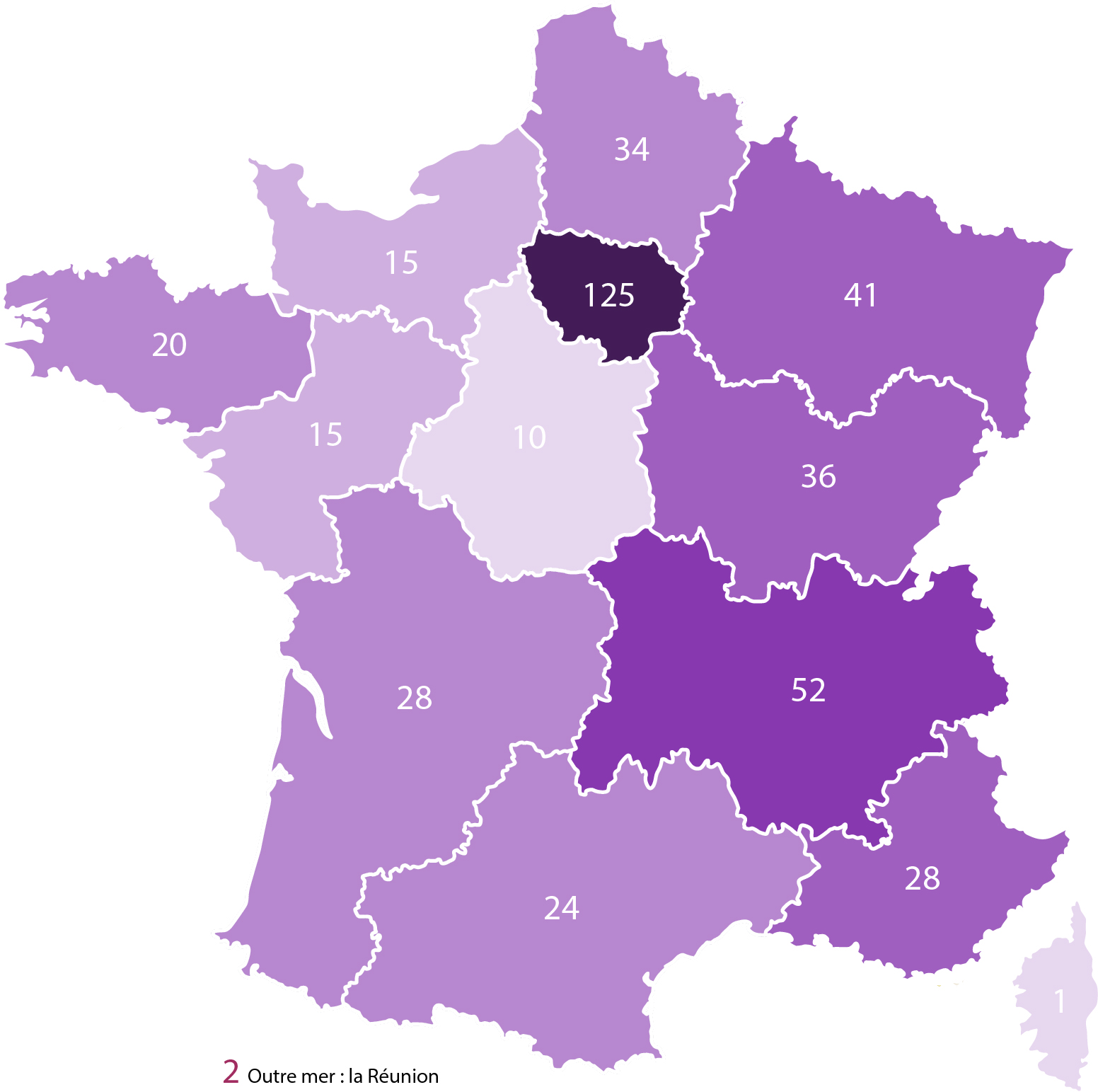
In our directory, 435 people declare that they work on themes related to the end of life.
Women are more represented than men (64% versus 36%).
68% of these researchers are affiliated with a research unit.
161 directory members conduct research while practicing in hospital or medical departments.
| Number of research units | Number of researchers |
|---|---|
| 165 research units (EA, UR, UMR, UPR, UAR...) | 295 |
| 10 clinical research structures (CIC, URC, UIC) | 22 |
Subject areas
Our classification, built on the basis of researcher declarations, includes 56 specialties. 49% belong to the medical, paramedical and life sciences. 51% belong to the humanities and social sciences.
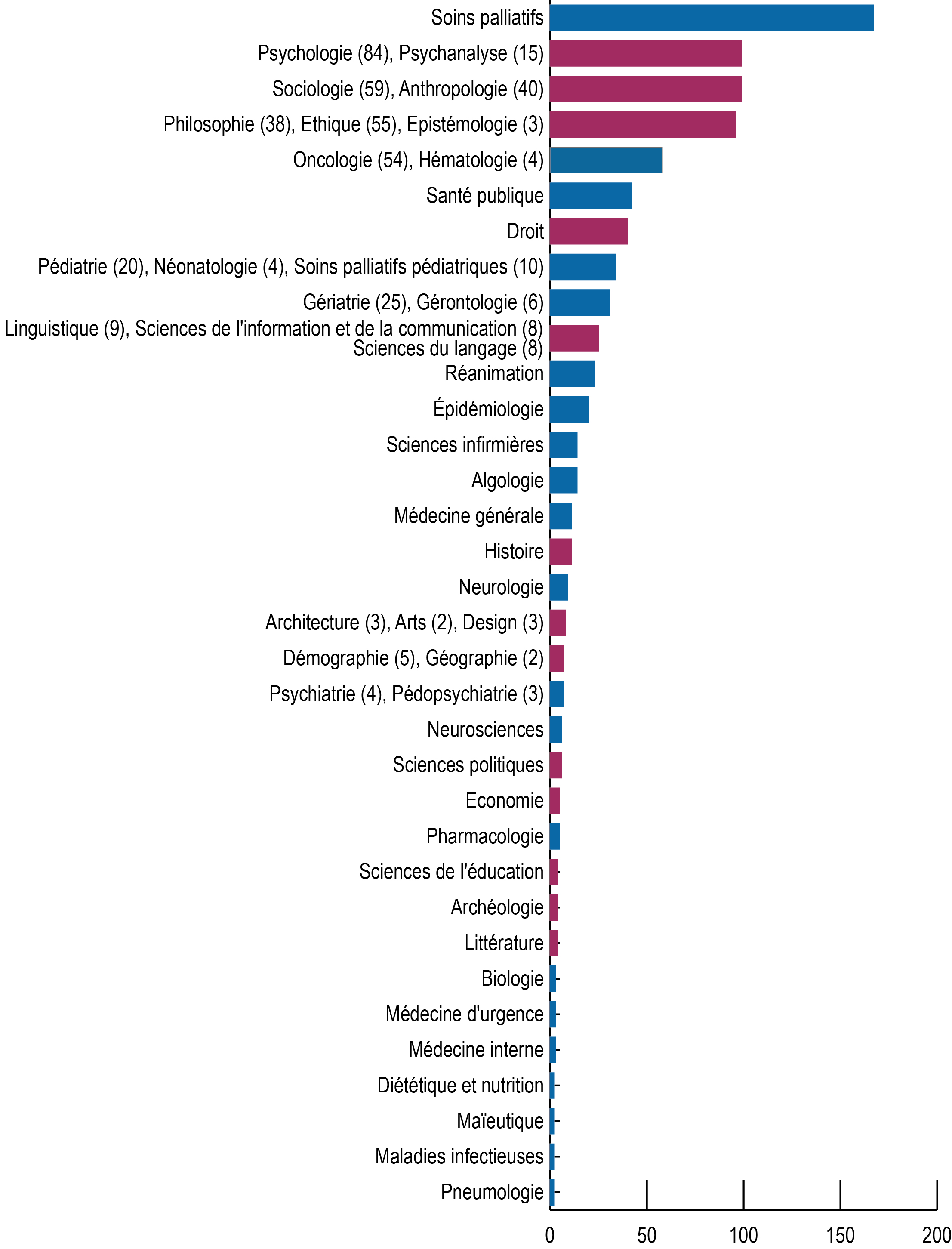
Excluded from this chart are disciplines with only one occurrence, namely cardiology, forensic medicine, clinical pharmacy, psychomotricity, theology, image semiotics, genetics and mathematics.
Methodology
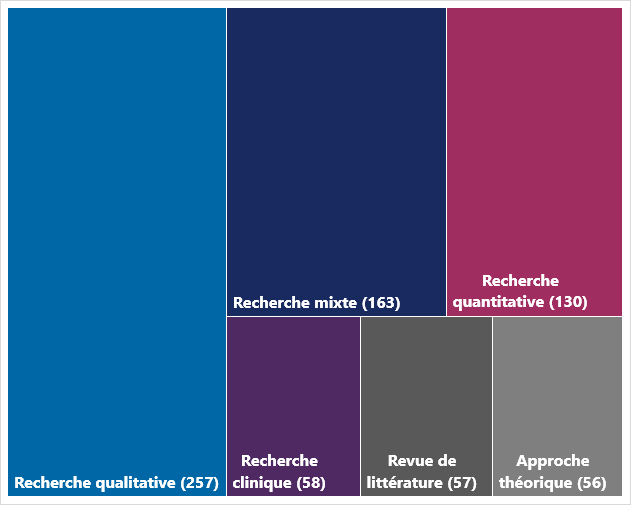
A single person may have reported using several methods in their research work. The graph below shows the number of researchers using each method:
Populations and pathologies
The populations predominantly studied are palliative care patients, cancer patients, healthcare professionals and the elderly.
| Palliative care patients | 126 |
| Cancer | 112 |
| Health care professionals | 101 |
| Aging and the elderly | 88 |
| Loved ones and caregivers | 72 |
| Vulnerable people | 60 |
| Neurodegenerative diseases | 46 |
| Resuscitation | 38 |
| Pediatrics | 32 |
| People with disabilities | 26 |
| Organ failure: nephrology (6), cardiology (9), pneumology (8) | 23 |
| Adolescents and young adults | 21 |
| Psychiatric illnesses | 20 |
| Funeral professionals | 17 |
| Primary care and general medicine (13), internal medicine (2) | 15 |
| Neonatology | 13 |
| Volunteers | 11 |
| Genetic diseases | 9 |
| Populations of the past | 7 |
| Emergency medicine | 7 |
| Patient partners | 7 |
| Migrants | 6 |
| Orphans | 6 |
| Obesity | 1 |
Research topics
| End-of-life locations: home (53), institutional (62) | 115 |
| Ethics/Bioethics | 102 |
| Experiences and perceptions of the end of life | 95 |
| Patient support | 94 |
| Accompanying relatives and caregivers | 81 |
| Anticipation / Advance directives | 81 |
| Decision-making processes | 77 |
| Social and cultural representations | 68 |
| Mourning | 67 |
| Death wish / Euthanasia / Assisted suicide | 65 |
| Sedation | 61 |
| Law and legislation | 54 |
| Evaluation of professional practices / Devices / Tools and scales | 54 |
| Psychic and existential suffering | 54 |
| Quality of life | 50 |
| Early palliative care | 50 |
| Pain management | 46 |
| Care path | 44 |
| History of palliative care (16) / History of death (28) | 44 |
| Professional training / Pedagogy | 43 |
| Communication | 37 |
| Drugs/Therapeutics/Medical Devices | 34 |
| Interprofessional collaborations | 33 |
| Symptom assessment and management | 31 |
| Organization of care | 31 |
| Autonomy and people at the end of life | 26 |
| Spirituality and religion | 26 |
| Limitation and cessation of treatment | 23 |
| Philosophy of death | 22 |
| Funeral practices/Post-mortem care | 20 |
| Organ donation and procurement | 19 |
| Health policies | 19 |
| Food / Artificial nutrition | 17 |
| Alternative and complementary medicine | 12 |
| Agonie | 11 |
| Pandemic - Covid 19 | 11 |
| Therapeutic education | 10 |
| Public debate analysis | 8 |
| Depressive disorders | 7 |
| Biology of aging | 6 |
| Economic issues | 6 |
| Supporting care | 6 |
| Predictive markers of death / Prognostic factors | 3 |
| Neurobiological mechanisms of death | 2 |
The theses
Since 2019 we have been listing theses on topics related to end-of-life and palliative care (source theses.fr).
However, this census is not exhaustive and does not take into consideration theses for practice in medicine or pharmacy.
In 2023, there were19 thesis registrations (7 more than the previous year) and 14 theses defended (20 more than previously). In total 58 theses have been defended since 2019.
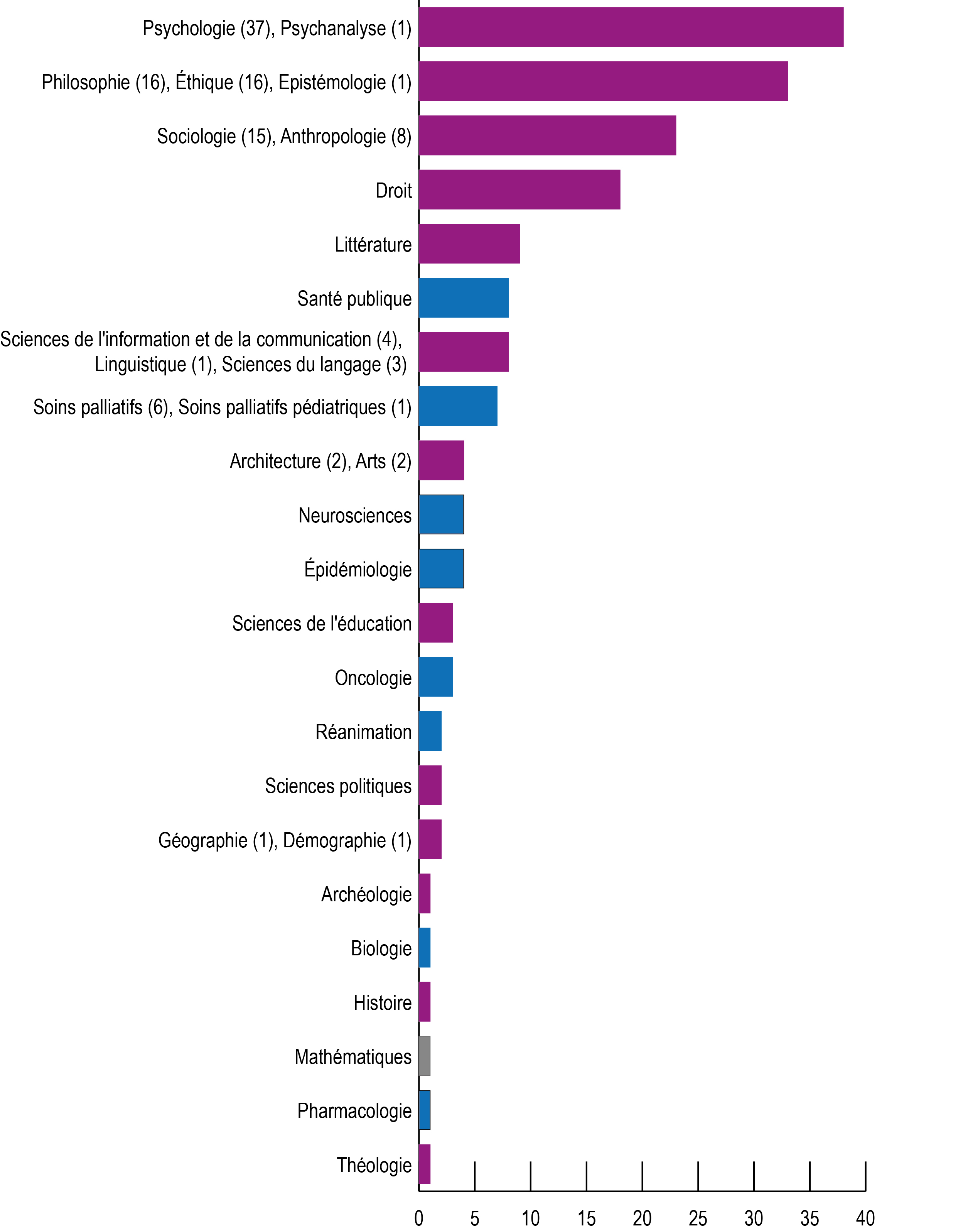
As of May 2024, 100 theses are in progress. Of these, 81% are being carried out in human and social sciences (SHS) laboratories, and the majority are by women (73%).
Disciplinary fields
Themes
The data below concerns both theses in progress and theses defended.
| Themes | Number of theses |
| Experiences and perceptions of the end of life | 33 |
| Mourning | 29 |
| Ethics, bioethics | 24 |
| Law and Legislation | 18 |
| Funeral practices/Post-mortem care | 15 |
| Death wish / Euthanasia / Assisted suicide | 14 |
| Social and cultural representations | 13 |
| Patient support | 12 |
| End of life in a hospital/medical-social establishment | 9 |
| Decision-making processes | 8 |
| Organization of care | 7 |
| Support for relatives and caregivers | 6 |
| Anticipation / Advance directives | 6 |
| Autonomy for people at the end of life | 6 |
| Interprofessional collaboration | 6 |
| Symptom assessment and management | 6 |
| Philosophy of death | 6 |
| Psychic and existential suffering | 6 |
| Communication | 5 |
| Limitation and cessation of treatment | 5 |
| Care path | 5 |
| Organ donation and procurement | 4 |
| Health policies | 4 |
| Sedation | 4 |
| Evaluation of professional practices / devices / tools and scales | 3 |
| Predictive markers of death / Prognostic factors | 3 |
| Pain management | 3 |
| Early palliative care | 3 |
| End of life at home | 2 |
| Analysis of the public debate | 1 |
| Professional training / Pedagogy | 1 |
| Neurobiological mechanisms of death | 1 |
| Drugs / Therapeutics / Medical Devices | 1 |
| Economic issues | 1 |
| Spirituality and religion | 1 |
Project directory
The research projects directory has 20 more projects than the previous year: 87 projects in total were posted by our network members.
The sources of funding are diverse: Institut national du cancer (INCa), Agence nationale de la recherche (ANR), Direction générale de l'offre de soins (DGOS) of the Ministry of Health and Prevention, Fondation de France...
These projects are listed on the initiative of researchers and doctoral students. The list is therefore not exhaustive.
These projects are listed on the initiative of researchers and doctoral students
Disciplinary fields
| Disciplines mentioned | Number of projects |
| Palliative care | 39 |
| Psychology (26), Psychoanalysis (1) | 27 |
| Sociology (16), Anthropology (10) | 26 |
| Oncology (13), Hematology (1) | 14 |
| Public Health | 14 |
| Philosophy (3), Ethics (10) | 13 |
| Law | 12 |
| Nursing | 7 |
| Linguistics (3), Information and Communication Sciences (2), Language Sciences (2) | 7 |
| Architecture (4), Arts (1) | 5 |
| Educational sciences | 5 |
| Demography (3), Geography (1) | 4 |
| Epidemiology | 4 |
| General Medicine | 3 |
| Economics | 2 |
| Neurology | 2 |
| Emergency Medicine | 2 |
| Resuscitation | 2 |
| Geriatrics | 2 |
| Algology | 1 |
| History | 1 |
| Physiotherapy | 1 |
| Nephrology | 1 |
| Neuroscience | 1 |
| Pediatrics | 1 |
| Pharmacology | 1 |
| Political Science | 1 |
| Biology | 1 |
Themes
The topics covered in these projects are diverse.
| End-of-life locations: home (20), institutional (25) | 45 |
| Support for relatives and caregivers | 26 |
| Patient support | 25 |
| Experiences and perceptions of the end of life | 24 |
| Evaluation of professional practices / devices / tools and scales | 20 |
| Anticipations / Advance directives | 17 |
| Mourning | 17 |
| Law and legislation | 14 |
| Decision-making processes | 13 |
| Death wish / Euthanasia / Assisted suicide | 12 |
| Care path | 12 |
| Sedation | 11 |
| Quality of life | 11 |
| Social and cultural representations | 10 |
| Ethics/Bioethics | 10 |
| Professional training / Pedagogy | 10 |
| Autonomy for people at the end of life | 9 |
| Organization of care | 9 |
| History of death (6), History of palliative care (2) | 8 |
| Early palliative care | 8 |
| Communication | 7 |
| Interprofessional collaborations | 6 |
| Symptom assessment and management | 6 |
| Drugs / Therapeutics / Medical Devices | 6 |
| Psychic and existential suffering | 6 |
| Philosophy of death | 5 |
| Health policies | 5 |
| Limitations and cessation of treatment | 4 |
| Funeral practices/Post-mortem care | 4 |
| Therapeutic education | 3 |
| Pandemic - Covid 19 | 3 |
| Agonie | 2 |
| Pain management | 2 |
| Spirituality and religion | 2 |
| Predictive markers of death / Prognostic factors | 2 |
| Food / artificial nutrition | 1 |
| Organ donation and procurement | 1 |
| Economic issues | 1 |
| Supporting care | 1 |
European projects
In 2023, 14 Horizon Europe projects on the end-of-life theme are being funded. Of these, 7 new projects have been selected under the call for projects (HORIZON-HLTH-2023-DISEASE-03-01) Novel approaches for palliative and end-of-life care for non-cancer patients.
Only one, the INSPIRE project, is coordinated by France. However, French teams are involved in 4 of these projects.
By 2019, 5 Horizon 2020 projects had been funded: Diadic, MyPal, The iLIVE project, Palliative sedation and PD-PAL Project.
We also count since 2018, 3 ERC Starting Grant projects and 3 ERC Consolidator Grant projects with host institutions located in the Netherlands, UK, Spain and Portugal.
A COST (European Cooperation in Science and Technology) project entitled COllaboratively DEveloped culturallY Appropriate and inclusive Assessment tool for Palliative Care EDUcation started in 2023.
For more information, see the page dedicated to European projects on our website
Updated on 14/05/2024
Data extraction and processing: Sophie Aupet