
2027 International Francophone Science Day
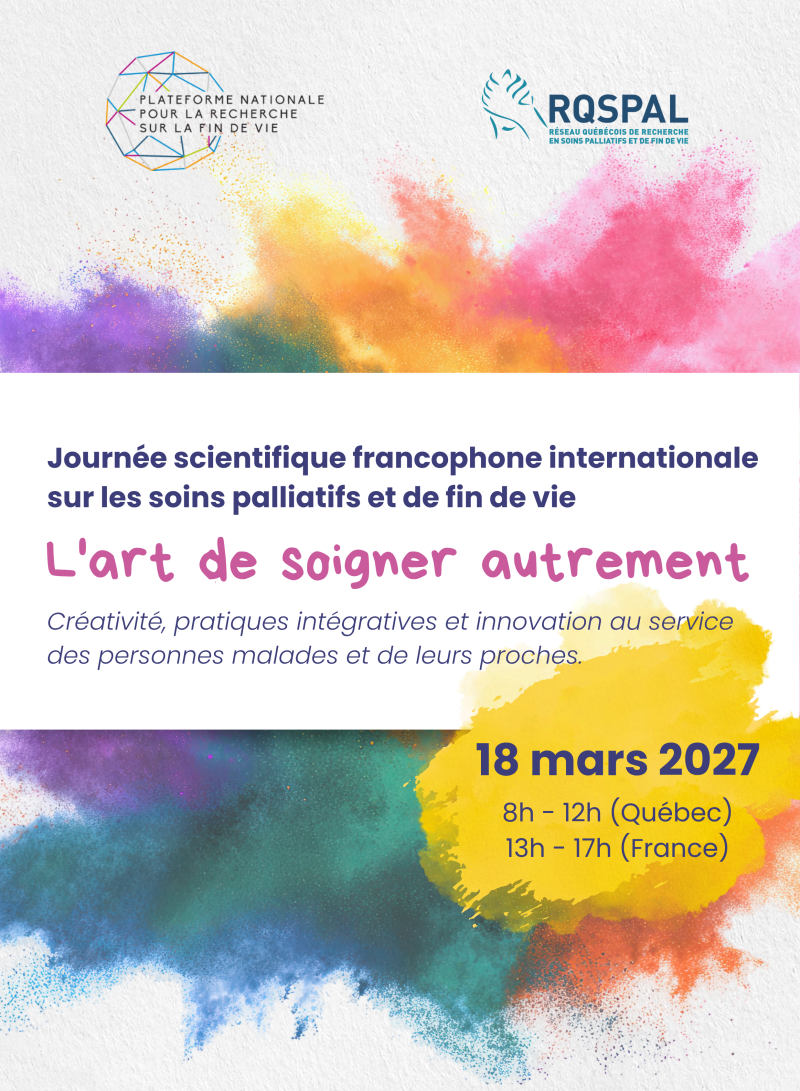
The National Platform for Research on End-of-Life Care and the Quebec Network for Research in Palliative and End-of-Life Care are jointly organizing their seventh international Francophone scientific conference on palliative and end-of-life care. This year’s theme is: “The Art of Caring Differently: Creativity, Integrative Practices, and Innovation in the Service of Patients and Their Loved Ones.”
The Art of Care: A Different Approach. Creativity, integrative practices, and innovation in the service of patients and their loved ones
Thursday, March 18, 2027, online
from 8 a.m. to 12 p.m. (Quebec time) and from 1 p.m. to 5 p.m. (French time)
The call for papers is open from September 21 to November 20, 2026.
Submit an abstract
Palliative and end-of-life care is based on a holistic, interdisciplinary approach centered on the patient and their loved ones. It aims to address physical, psychological, social, spiritual, cultural, and relational needs throughout the course of the illness, until death, and during the grieving process. This holistic approach calls for drawing on a variety of knowledge, disciplines, and care modalities to improve quality of life, support the coping abilities of those affected, and promote care that is imbued with humanity.
In this context, creativity, integrative practices, innovative practices, and art are playing an increasingly important role in palliative and end-of-life care. This is reflected in a wide variety of initiatives aimed at enriching care, strengthening relationships between patients, their loved ones, and health and social service professionals and providers, to support communication, to foster the search for meaning in the experience of the end of life and grief, to encourage self-expression, to preserve social and family ties, and to improve the care experience and well-being of those involved.
These approaches take various forms: artistic interventions (music, visual arts, writing, theater, dance, photography, etc.), art therapy, integrative practices, clinical, organizational, educational, or digital innovations, participatory approaches, partnerships with cultural institutions, and new models of support. Their development is attracting growing interest from the research community, which aims to better understand their effects, the conditions under which they are implemented, and their contribution to the evolution of palliative and end-of-life care. Furthermore, their integration also raises questions regarding the quality of scientific data, safety, accessibility, training for practitioners, necessary resources, and the conditions that foster sustainable and equitable implementation.
In general, the issues surrounding creativity, integrative practices, innovative practices, and the role of art in palliative and end-of-life care include, in particular:
- The development of scientific knowledge: gaining a better understanding of the effects, mechanisms of action, conditions for implementation, and outcomes of these approaches for patients, their loved ones, and other relevant stakeholders.
- Support for patients and their loved ones: exploring approaches that promote quality of life, communication, self-expression, maintaining relationships, participation in care, and grief support.
- Innovation in practices: presenting clinical, community-based, organizational, educational, or technological initiatives that enhance palliative and end-of-life care.
- Knowledge development and sharing: promoting evaluation, knowledge transfer, and interdisciplinary collaborations to support the evolution of practices.
This international Francophone scientific conference will provide an opportunity to present the latest research findings on creativity, integrative practices, innovative approaches, and the role of art in palliative and end-of-life care. It will foster exchanges among researchers, clinicians, professionals, volunteers, students, patients, family members, partners, cultural sector stakeholders, and decision-makers to share knowledge, combine expertise, and identify opportunities for developing these approaches through
international collaboration.
Objectives
- To share research findings on creativity, integrative practices, innovative practices, and the role of art in palliative and end-of-life care.
- Identify and better understand the benefits of these approaches for patients, their loved ones, and the various stakeholders involved in their care.
- To explore innovations and research initiatives that contribute to the evolution of practices in palliative and end-of-life care.
- Identify future research directions that promote the development, evaluation, and transfer of knowledge in this field.
Speakers who wish to do so will be invited to write an article that may be submitted for publication in the journal Médecine Palliative within one year following the International Francophone Scientific Day.
Research abstracts must be submitted via an online form on this website.
Call for Papers
The organizing committee is seeking five speakers from the research community for this event.
We invite established researchers or clinical researchers with in-depth knowledge and research data/findings to present on topics related to the theme (literature reviews are also accepted). The last edition of this event attracted over 500 registrations (from Quebec, Europe, and Africa).
This virtual International Francophone Scientific Day will be an opportunity to showcase current research in Quebec, France, and around the world on creativity, integrative and innovative practices, and the role of art
in the care of patients and their loved ones.
Five 40-minute sessions are scheduled, each consisting of a 25- to 30-minute presentation followed by a 10- to 15-minute discussion period. It is essential to respect the discussion time, as the event is designed to be interactive.
Download the call for papers
Access the submission form
Deadline for abstract submission
November 20, 2026
Response from the organizing committee
December 16, 2026
Guidelines for preparing your abstract:
- Maximum 300 words
- Given the French-speaking nature of the event, both the paper and the presentation must be in French. Please pay attention to the quality of the French used.
- Be sure to clearly demonstrate the relevance and purpose of your research presentation
(research data/results or a literature review) in
relation to the theme. - The use of tables, graphs, or images is not permitted in
abstracts. - Use generic drug names.
- The use of acronyms and abbreviations is permitted provided that you write out the full word the first time you use it in the text (place the acronym in parentheses).
- Do not capitalize the title or any part of your abstract. The title should be
no more than 12 words long. - Carefully proofread your abstract and ensure that your French is of high quality and free of spelling errors. Use a spell-checker if necessary
- Format for scientific/research abstracts:
- We strongly recommend this format for your abstract: A) Background, B) Objectives, B) Research Methodology, C) Results, D) Discussion
- The discussion must be supported by research data. Literature reviews are also welcome.