

Research Overview 2026
Each year, the Platform compiles an Overview of French Research using four databases: the National Directory of Researchers, the directory of research projects, the directory of European projects, and the thesis directory.
The Researchers' Network
Distribution

In our directory, 464 people declare that they work on themes related to the end of life. Six years ago, there were 312, an increase of 48,7%.
Women are more represented than men (64% versus 36%).
66,8% of these researchers are affiliated to a research unit.
139 directory members conduct research while practicing in hospital or medical services.
| Number of research units | Number of researchers.s |
|---|---|
| 176 research units (EA, UR, UMR, UPR, UAR...) | 310 |
| 10 clinical research structures (CIC, URC, UIC) | 12 |
Disciplinary fields
Our classification, built on the basis of researcher declarations, counts 57 specialties. 48% belong to the medical, paramedical and life sciences and 52% to the humanities and social sciences.

Not included in this chart are disciplines with only one occurrence, namely: cardiology, forensic medicine, clinical pharmacy, psychomotricity, image semiotics, genetics, mathematics, maieutics and biostatistics.
Methodology
A single person may have reported using several methods in their research work. The graph below shows the number of researchers.s using each method:

Populations and pathologies
The populations predominantly studied are palliative care patients, cancer patients, healthcare professionals and the elderly, as well as relatives and caregivers.
| Palliative care patients | 128 |
| Cancer | 115 |
| Health professionals professionals | 112 |
| Aging and older people and the elderly | 88 |
| Family and caregivers | 83 |
| Vulnerable vulnerable | 63 |
| Neurodegenerative diseases | 49 |
| Resuscitation | 41 |
| Pediatrics, children, neonatology | 40 |
| Persons with disabilities | 28 |
| Teens and young adults | 24 |
| Funeral professionals | 23 |
| Psychiatric diseases | 21 |
| Organ failure: nephrology (6), cardiology (7), pulmonology (7) | 20 |
| Primary care and general medicine (14), Internal Medicine (2) | 16 |
| Volunteers | 13 |
| Emergency Medicine | 11 |
| Past populations | 9 |
| Patients partners | 8 |
| Genetic diseases | 7 |
| Migrants | 6 |
| Orphans | 6 |
| Obesity | 1 |
Research themes
| End-of-life settings: home (54), institutional (67) | 121 |
| Ethical issues | 113 |
| Patient support | 107 |
| Experiences and perceptions of end of life | 99 |
| Support for loved ones and caregivers | 95 |
| Anticipation / Advance directives | 87 |
| Decision-making processes | 83 |
| Social and cultural representations | 78 |
| Bereavement | 77 |
| Death Wish/Euthanasia/Assisted Suicide | 69 |
| Sedation | 68 |
| Evaluation of professional practices / Devices / Tools and scales | 62 |
| Psychic and existential suffering | 62 |
| Law and legislation | 56 |
| Quality of life | 56 |
| Early palliative care | 56 |
| History of palliative care (18) / History of death (31) | 49 |
| Pain management | 48 |
| Care pathways | 48 |
| Professional training/Pedagogy | 45 |
| Communication | 42 |
| Drugs / Therapeutics / Medical Devices | 38 |
| Interprofessional collaborations | 35 |
| Symptom assessment and management | 34 |
| Organization of care | 33 |
| Limitation and discontinuation of treatment | 32 |
| Spirituality and religion | 28 |
| Philosophy of death | 27 |
| Funeral practices/Post-mortem care | 27 |
| Autonomy and people at the end of life | 26 |
| Health policy | 26 |
| Organ donation and procurement | 19 |
| Food / Artificial nutrition | 16 |
| Agonia | 14 |
| Pandemic - Covid 19 | 13 |
| Alternative and complementary medicine | 12 |
| Analysis of the public debate | 11 |
| Therapeutic education | 10 |
| Depressive disorders | 9 |
| Supportive care | 9 |
| Economic issues | 7 |
| Biology of aging | 6 |
| Predictive markers of death/Prognostic factors | 3 |
| Neurobiological mechanisms of death | 3 |
| Analysis of causes of death | 1 |
| Animal mediation | 1 |
Research Topics
There are 59 topics (before grouping). A single person may list multiple topics: 2,168 mentions were recorded, for an average of 4.7 topics per researcher.
| Topic (after grouping) | Number of researchers | Percentage |
|---|---|---|
| Places of end-of-life care: at home (66), in a care facility (78) | 144 | 31% |
| Palliative care | 134 | 28.9% |
| Patient support | 122 | 26.3% |
| Ethical issues | 113 | 24.4% |
| Support for family members and caregivers | 101 | 21.8% |
| Experiences and perceptions of the end of life | 94 | 20.3% |
| Planning for the Future / Advance Directives | 91 | 19.6% |
| Social and cultural perceptions | 81 | 17.5% |
| Decision-making processes | 80 | 17.2% |
| Grief | 79 | 17% |
| Desire for death / Euthanasia / Assisted suicide | 78 | 16.8% |
| Sedation | 69 | 14.9% |
| Evaluation of professional practices / Systems / Tools and scales | 67 | 14.4% |
| Psychological and existential suffering | 65 | 14% |
| History of death (38), History of palliative care (23) | 61 | 13.1% |
| Quality of life | 60 | 12.9% |
| Law and Legislation | 58 | 12.5% |
| Early Palliative Care | 56 | 12.1% |
| Professional Training / Education | 51 | 11% |
| Care Pathways | 51 | 11% |
| Pain management | 49 | 10.6% |
| Autonomy of people at the end of life | 43 | 9.3% |
| Communication | 42 | 9.1% |
| Organization of care | 39 | 8.4% |
| Medications / Therapies / Medical Devices | 38 | 8.2% |
| Symptom Assessment and Management | 36 | 7.8% |
| Interprofessional collaboration | 35 | 7.5% |
| Treatment limitations and discontinuation | 34 | 7.3% |
| Philosophy of Death | 32 | 6.9% |
| Topic (after grouping) | Number of researchers | Percentage |
|---|---|---|
| Spirituality and religion | 29 | 6.2% |
| Funeral Practices and Settings / Postmortem Care | 27 | 5.8% |
| Health Policies | 26 | 5.6% |
| Organ donation and procurement | 20 | 4.3% |
| Analysis of public debate | 16 | 3.4% |
| Agony | 15 | 3.2% |
| Unconventional and non-reimbursed care practices | 15 | 3.2% |
| Diet / Artificial Nutrition | 14 | 3% |
| Palliative Care | 14 | 3% |
| Primary care | 14 | 3% |
| Pandemic - COVID-19 | 13 | 2.8% |
| Support for healthcare providers1 | 10 | 2.2% |
| Therapeutic Education | 10 | 2.2% |
| Economic Issues | 8 | 1.7% |
| Depressive Disorders | 7 | 1.5% |
| Biology of Aging | 6 | 1.3% |
| Aging | 5 | 1.1% |
| Democracy and health | 4 | 0.9% |
| Neurobiological mechanisms of death | 4 | 0.9% |
| Digital technologies (AI, telemedicine, etc.)1 | 4 | 0.9% |
| Predictive markers of death / Prognostic factors | 3 | 0.6% |
| Psychedelic-assisted therapies1 | 3 | 0.6% |
| Health equity1 | 2 | 0.4% |
| End-of-life suicides1 | 2 | 0.4% |
| Overseas territories1 | 2 | 0.4% |
| Analysis of causes of death | 1 | 0.2% |
| Animal-assisted therapy | 1 | 0.2% |
| Sexual health | 1 | 0.2% |
- Topic introduced in 2025/2026: The low numbers reflect the newness of the category and not a lack of research activity
The Directory of Research Projects
Volume, Dynamics, and Progress
There are now 102 research projects listed (compared to 67 in 2023). As a reminder, this directory is updated at the researchers’ initiative. Three out of four projects are currently underway.
Disciplinary Fields
| Discipline (after grouping) | Projects | Percentage |
| Palliative Care | 42 | 41.2% |
| Psychology (29), Psychoanalysis (1) | 30 | 29.4% |
| Sociology (18), Anthropology (12) | 30 | 29.4% |
| Oncology (16), Hematology (1) | 17 | 16.7% |
| Philosophy (3), Ethics (11) | 14 | 13.7% |
| Public Health | 14 | 13.7% |
| Law | 12 | 11.8% |
| Linguistics (3), Information and Communication Sciences (3), Linguistics (2) | 8 | 7.8% |
| Nursing | 7 | 6.9% |
| Education | 6 | 5.9% |
| Architecture and Urban Planning (4), Arts (1) | 5 | 4.9% |
| Demography (3), Geography (2) | 5 | 4.9% |
| Epidemiology | 4 | 3.9% |
| General Medicine | 4 | 3.9% |
| Pain Medicine | 3 | 2.9% |
| Economics | 3 | 2.9% |
| Geriatrics (2), Gerontology (1) | 3 | 2.9% |
| Intensive Care | 3 | 2.9% |
| Emergency Medicine | 2 | 2% |
| Neurology | 2 | 2% |
Other (1 project each): biology, ethnology, history, physical therapy, nephrology, neuroscience, pediatrics, pharmacology, political science, pediatric palliative care, other medical specialties.
Funding Sources
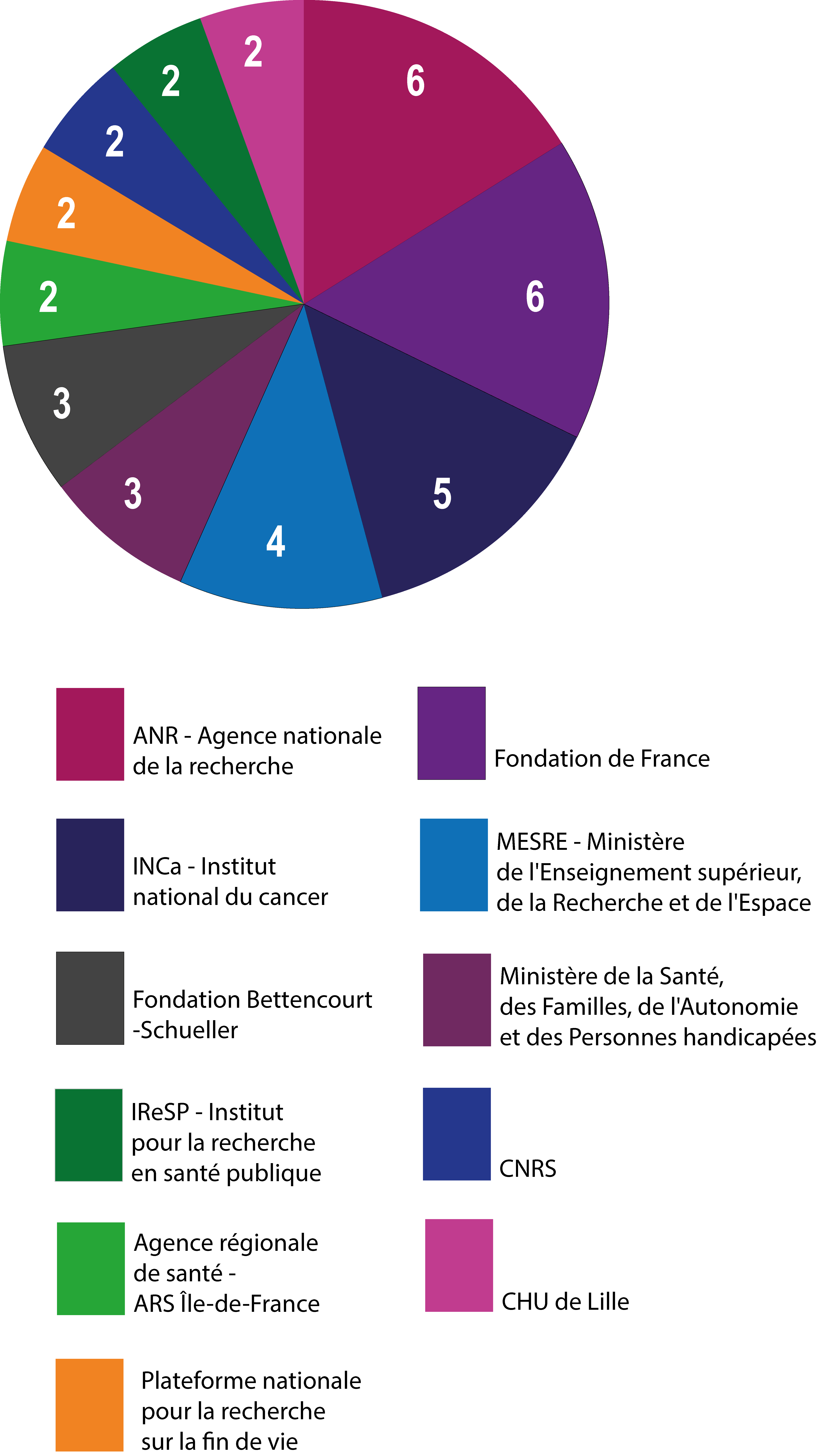
Of 104 projects, 62 mention at least one funding source. The sources are highly diverse.
This dispersion indicates a field that is not backed by any major overarching program, but rather brings together a multitude of modest-scale funding sources: national agencies, private foundations, local governments, and healthcare institutions. This underscores the importance of large-scale funding programs in this field. As a reminder, the first Interdisciplinary Research Program on End-of-Life Care was launched in 2025.
Topics
| Topic (after grouping) | Projects | Percentage |
| End-of-life care settings: at home (21), in a care facility (26) | 47 | 46.1% |
| Patient support | 33 | 32.4% |
| Support for family members and caregivers | 29 | 28.4% |
| Experiences and perceptions of end-of-life | 26 | 25.5% |
| Evaluation of professional practices / Systems / Tools and scales | 23 | 22.5% |
| Grief | 19 | 18.6% |
| Planning ahead / Advance directives | 18 | 17.6% |
| Care pathways | 16 | 15.7% |
| Decision-making processes | 16 | 15.7% |
| Quality of life | 15 | 14.7% |
| Social and Cultural Perceptions | 15 | 14.7% |
| Law and Legislation | 14 | 13.7% |
| Professional Training / Pedagogy | 14 | 13.7% |
| Death wish / Euthanasia / Assisted suicide | 13 | 12.7% |
| Ethical issues | 12 | 11.8% |
| Organization of care | 11 | 10.8% |
| Sedation | 11 | 10.8% |
| Autonomy of people at the end of life | 10 | 9.8% |
| Assessment and management of symptoms | 9 | 8.8% |
| History of death (7), History of palliative care (2) | 9 | 8.8% |
| Interprofessional collaboration | 8 | 7.8% |
| Communication | 8 | 7.8% |
| Medications / Therapies / Medical Devices | 8 | 7.8% |
| Psychological and Existential Suffering | 8 | 7.8% |
| Health policies | 7 | 6.9% |
| Funeral practices and settings / Postmortem care | 7 | 6.9% |
| Early palliative care | 7 | 6.9% |
| Treatment limitations and withdrawal | 5 | 4.9% |
| Philosophy of death | 5 | 4.9% |
| Pain management | 5 | 4.9% |
| Support for Caregivers | 3 | 2.9% |
| Agony | 3 | 2.9% |
| Therapeutic education | 3 | 2.9% |
| Pandemic – COVID-19 | 3 | 2.9% |
| Spirituality and religion | 3 | 2.9% |
| Predictors of death / Prognostic factors | 2 | 2% |
| Economic issues | 2 | 2% |
| Supportive care | 2 | 2% |
| Diet / Artificial Nutrition | 1 | 1% |
| Organ Donation and Transplantation | 1 | 1% |
Lead Institutions
Research on end-of-life care is conducted in roughly equal measure by universities and healthcare institutions, which distinguishes it from many other fields.
| Lead Institution | Projects |
| Besançon University Hospital | 7 |
| University of Lille | 5 |
| Léon Bérard Center | 4 |
| Clermont Auvergne University | 4 |
| University of Strasbourg | 3 |
| Lille University Hospital | 3 |
| Valenciennes Hospital | 3 |
Each leads 2 projects: Assistance publique - Paris Public Hospitals, Sorbonne University, Sorbonne Nouvelle, Tours Regional University Hospital Center, National Institute for Demographic Studies (INED), Strasbourg University Hospitals, Santé Service Foundation, and Paris Nanterre University.
Theses
Since 2019 we have been listing theses on subjects related to end-of-life and palliative care (source theses.fr).
However, this census is not exhaustive and does not take into account theses practicing in medicine or pharmacy.
In 2025, there were 18 thesis registrations (stable compared with the previous year) and 8 theses defended (14 more than previously). In total 73 theses have been defended since 2019.
As of June 2025, 92 theses are in progress. These are 81% in Humanities and Social Sciences units and mostly by women (77%).
Disciplinary fields

Themes
The data below concerns both theses in progress and theses defended.
| Themes | Number of theses |
| Experiences and perceptions of the End-of-Life | 30 |
| Death wish/Euthanasia/Assisted suicide | 26 |
| Organ donation and removal | 19 |
| Psychic and existential suffering | 18 |
| Ethical issues | 15 |
| Health policies | 15 |
| Decision-making processes | 15 |
| Communication | 14 |
| Therapeutic education | 14 |
| Bereavement | 13 |
| Anticipation / Advance directives | 10 |
| Funeral practices / Post-mortem care | 10 |
| Patient support | 9 |
| Social and cultural representations | 9 |
| Care pathways | 8 |
| Support for relatives and carers | 7 |
| Law and legislation | 7 |
| End-of-Life in a hospital/medical-social institution | 7 |
| End-of-Life at home | 5 |
| Limitation and discontinuation of treatment | 5 |
| Organization of care | 5 |
| Pain management | 5 |
| Evaluation of professional practices/devices/tools and scales | 4 |
| Sedation | 4 |
| Early palliative care | 4 |
| Autonomy for people at the End-of-Life | 3 |
| Interprofessional collaborations | 3 |
| Symptom assessment and management | 3 |
| Philosophy of death | 3 |
| Professional training/Pedagogy | 2 |
| Predictive markers of death / Prognostic factors | 2 |
| Spirituality and religion | 1 |
| Analysis of public debate | 1 |
| Neurobiological mechanisms of death | 1 |
| Economic issues | 1 |
European Projects
We have improved the census of European projects on the end-of-life theme.
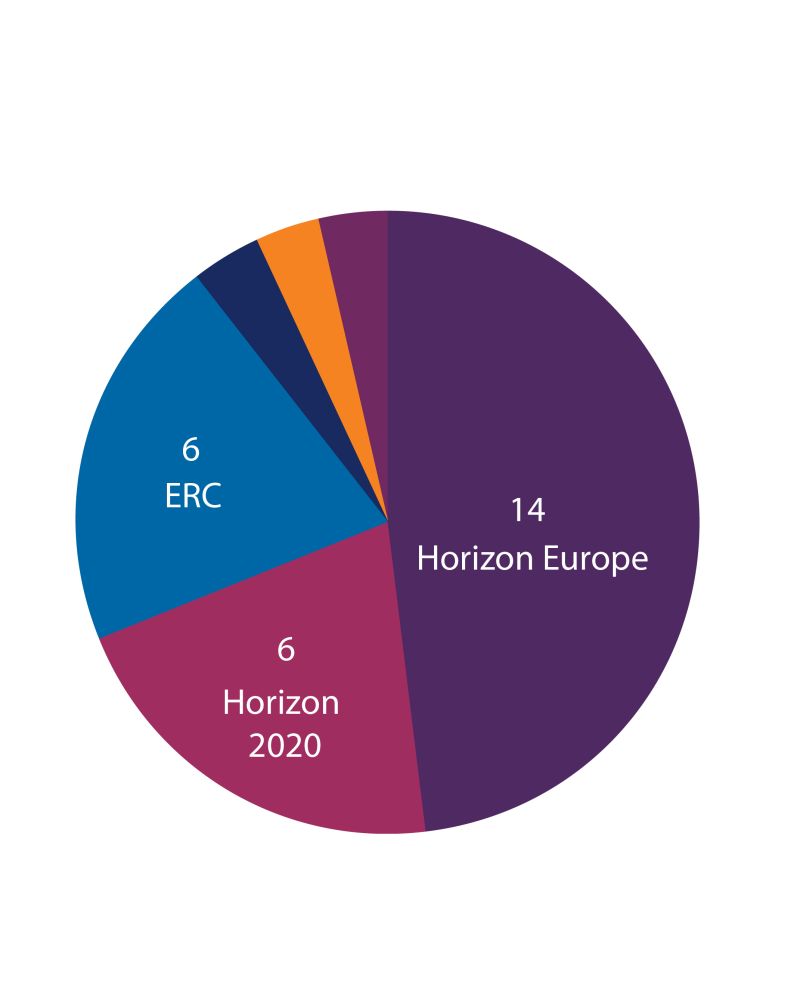
There are 31, mostly funded by Horizon Europe (14 projects), then Horizon 2020 and ERC (6 each). The COST (European Cooperation in Science and Technology), Interreg and Erasmus + programs are represented by just one project each.
These results show that the end-of-life theme is well integrated into major European research programs, particularly those geared towards innovation and basic research.
France appears as coordinator of only one project (the INSPIRE project). The countries most represented in project coordination are The Netherlands (8), Spain (5) and Belgium (8). Germany coordinates two, and Finland, Romania, Portugal, Italy, Greece, Norway and Ireland one each.
For more information, see the page dedicated to European projects on our website.
Updated 10/07/2025
Data extraction and processing: Sophie Aupet