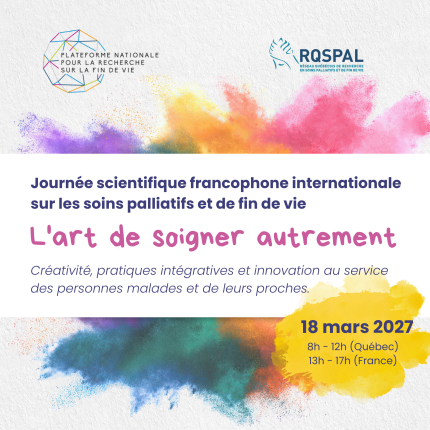

The Art of Alternative Care
Creativity, integrative practices, and innovations to support patients and their loved ones.
International Francophone Scientific Conference co-organized by the Quebec Network for Research in Palliative and End-of-Life Care (RQSPAL) and the National Platform for Research on the End of Life.
Palliative and end-of-life care is based on a holistic, interdisciplinary approach centered on the patient and their loved ones. It aims to address physical, psychological, social, spiritual, cultural, and relational needs throughout the course of the illness, up to the time of death and during the grieving process. This holistic approach calls for drawing on a variety of knowledge, disciplines, and support methods to improve quality of life, support the adaptive capacities of those affected, and promote care imbued with humanity.
In this context, creativity, integrative practices, innovative approaches, and art are playing an increasingly important role in palliative and end-of-life care. This is reflected in a wide variety of initiatives aimed at enriching care, strengthening relationships between patients, their loved ones, and health and social service professionals and providers, to support communication, to encourage the search for meaning in the end-of-life experience and the grieving process, to foster self-expression, to preserve social and family ties, and to improve the care experience and well-being of those involved.
These approaches take various forms: artistic interventions (music, visual arts, writing, theater, dance, photography, etc.), art therapy, integrative practices, clinical, organizational, educational, or digital innovations, participatory approaches, partnerships with cultural institutions, and new models of support. Their development is attracting growing interest from the research community, which aims to better understand their effects, the conditions under which they are implemented, and their contribution to the evolution of palliative and end-of-life care. Furthermore, their integration also raises questions regarding the quality of scientific data, safety, accessibility, training for practitioners, necessary resources, and the conditions that foster sustainable and equitable implementation.
The call for papers will be open from September 21 to November 20, 2026.
En ligne