
Launch of Interdisciplinary End-of-Life Research Program
The official event marking the start of work on the interdisciplinary End-of-Life Research Program took place on March 9 in Paris. The meeting provided an opportunity to present the ambitions of the four research consortia that have now been formed.
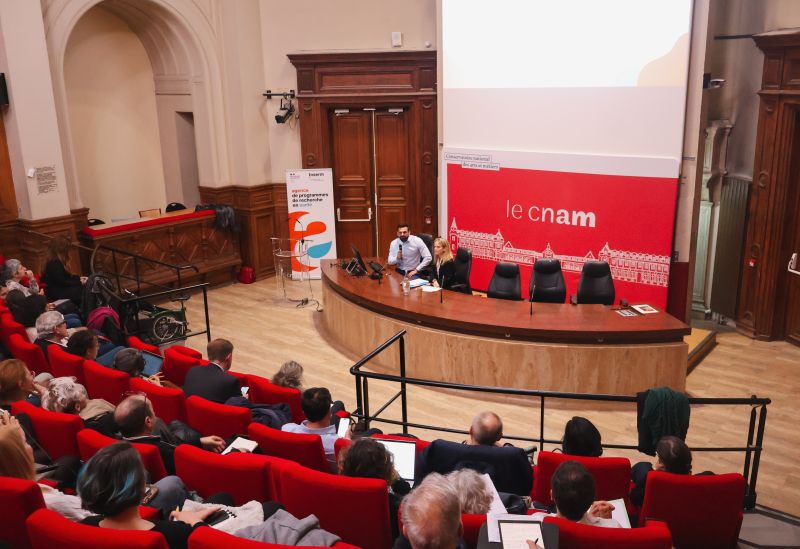
The interdisciplinary End-of-Life research program, steered by the Agence de programmes de recherche en santé entrusted to Inserm is part of the Ten-year strategy for supportive care and aims to produce new knowledge, strengthen patients' capacity for expression and choice, improve care organizations and practices, inform public decision-making and bring together the research communities concerned. It receives operational support from the Plateforme nationale pour la recherche sur la fin de vie. This program has enabled, as part of a vast call for applications, to form four research consortia. The March 9, 2026 event, held on the premises of the Conservatoire national des arts et métiers (CNAM) in Paris, marked the official start of the research work and brought together around 100 participants.
Introductory speeches were given by Bénédicte FAUVARQUE-COSSON, General Administrator of the CNAM, Didier SAMUEL, Chairman and CEO of Inserm and President of the Agence de programmes de recherche en santé, and Hugues DAUSSY, President of the Université Marie et Louis Pasteur.
The focus was first on the international dimension of research, with a presentation by representatives of the Ministry of Europe and Foreign Affairs (Audelin CHAPPUIS and Solal CANQUETEAU). Then Joachim COHEN, a member of the End-of-Life Care Research Group (Belgium), put forward recommendations for including French research in a European dynamic.
Then, the scientific trajectory of the International Research Program on End-of-Life Care (PRI) was presented by Clément CORMI, its manager. Adrien EVIN, co-president of the Plateforme nationale pour la recherche sur la fin de vie explained the role and involvement of this network of researchers in the PRI. Régis AUBRY, one of PRI's two scientific coordinators, outlined the project to create a research register on requests for active assistance in dying.
After the screening of an excerpt from the documentary film Le prix de la vie, presented by Marie-Astrid LE THEULE and Mylène CANVEL, the presentation of the four research consortia's respective projects provided an opportunity to gauge the scope of the work ahead, the diversity of approaches mobilized, the real interdisciplinarity of the projects, and their impact on improving end-of-life support.
The consortium Wishes to die (Désirs de mort) led by Léonor FASSE and Mathilde GIFFARD aims to identify, describe, analyze and compare expressions of death wishes, as well as how they are received, interpreted and supported by loved ones and professionals. The populations studied will include adults, children and the elderly in palliative care, as well as family caregivers and healthcare professionals. In particular, this work will enable the development of new training materials for healthcare professionals, as well as providing researchers with recommendations for more representative and ethical studies.
The consortium Trajectoires et parcours en fin de vie, represented by Sophie PENNEC and Johanne SAISON will document and analyze the various forms of trajectories (residential, relational, medical, moral and subjective) and highlight inequalities in support. Analyses will be carried out in the general population, but also more specifically among the severely chronically mentally ill, in overseas communities, among children and among the elderly. The aim will be to understand how end-of-life rights and support systems are or are not resources that are effectively known and mobilized by the various players involved. The results will make it possible to assess the application of new legislative provisions, raise public authorities' awareness of the diversity of needs, better integrate professional support and propose new organizational models.
The consortium KAIROS, led by Matthieu FRASCA and Lucie SOURZAT, seeks to think about anticipation in palliative and end-of-life situations. Serious illnesses, combined with medical, social, organizational and legal vulnerabilities, lead to unstable trajectories. Decisions are often taken too late, under stress, and the gradation of care is poorly adjusted. Based on prognosis, we need to be able to anticipate the worsening of vulnerabilities and adapt the level of care to the complexity of situations. Research work will link population analysis, clinical practices, ethical and legal frameworks, and digital innovation. The consortium's ambition is to structure the legal and participatory framework for anticipation, to produce knowledge on the determinants and contexts of anticipation, and also to design, test and deploy clinical, educational and digital anticipation devices.
The Suffering and lived experience at the end of life consortium coordinated by Laure SERRESSE and Nancy KENTISH-BARNES focuses on extreme vulnerability (from the point of view of patients, and healthcare professionals) and the multidimensional aspects of suffering (physical, psychological, social, spiritual and institutional). Researchers will examine the invisibility of suffering and the gap that persists between actual experience, assessment and practical responses in terms of care and support. It proposes an integrated scientific framework that articulates all dimensions: lived experience, clinical assessment, technological monitoring, institutional dynamics and professional training, in order to transform care practices and inform support policies. Its aim is to characterize and conceptualize suffering, identify the mechanisms of its visibility and invisibility, find levers for improvement, develop and validate assessment tools, analyze end-of-life practices and bereavement trajectories, and finally translate knowledge into training and care practices.
A round table moderated by Sarah CARVALLO, co-president of the Plateforme nationale pour la recherche sur la fin de vie, highlighted the challenges of interdisciplinarity for end-of-life research, reminding us of the need to cross experiences, methods and perspectives. The day closed with a speech by Franck MOUTHON, Executive Director of the Agence de programmes de recherche en santé, who highlighted the role of the Plateforme in the prefiguration and launch of the PRI.
This meeting was an opportunity for researchers to meet and discuss their projects. Work can now begin.
Published March 20, 2026