

Looking back on a year of research abroad
To complete his training as a researcher, Guillaume Economos spent a year at the Cicely Saunder's Institute at King's College, London. Drawing on this experience, this young doctor is now seeking to use the strengths of the English model to develop palliative care research in France.
- How did this stay abroad fit into your career path?
I decided to go into palliative care after discovering it by chance during a medical internship. My internship was therefore focused on this field, and more specifically on research: I obtained a DESC1 in palliative care and completed the Master's Research in Palliative Care at the Université Paris-Est Créteil. Then, before taking up a position as head of clinic in 2019 at the CHU de Lyon, I wanted to experience international mobility and seized the opportunity offered by the Agence régionale de santé (ARS) to benefit from a "research year"2.
- Where did you choose to go?
I was interested in the most productive laboratories in the world in this sector. These were MD Anderson cancer Center in the USA, Mc Gill University in Canada, and Cicely Saunder's Institute of palliative care, policy and rehabilitation, at King's College, London. I finally opted for the latter because its approach to palliative care includes many pathologies (neurodegenerative, respiratory diseases...), whereas in France, we remain very focused on oncology.
- Who did you work with?
I benefited from excellent supervision, perfectly thought out in relation to the academic path I was destined to follow. My supervisor was Jonathan Koffman, a sociologist who has been doing palliative care research for the past ten years. I also teamed up with other people, both doctors and non-physicians, such as Prof. Irene Higginson, head of the department, and Dr. Sabrina Bajwa, in charge of clinical research, on other projects. It was extremely interesting for me to discover something other than clinical research. It gave me a much broader, cross-disciplinary view.
- What do you think of the Cicely Saunders Institute?
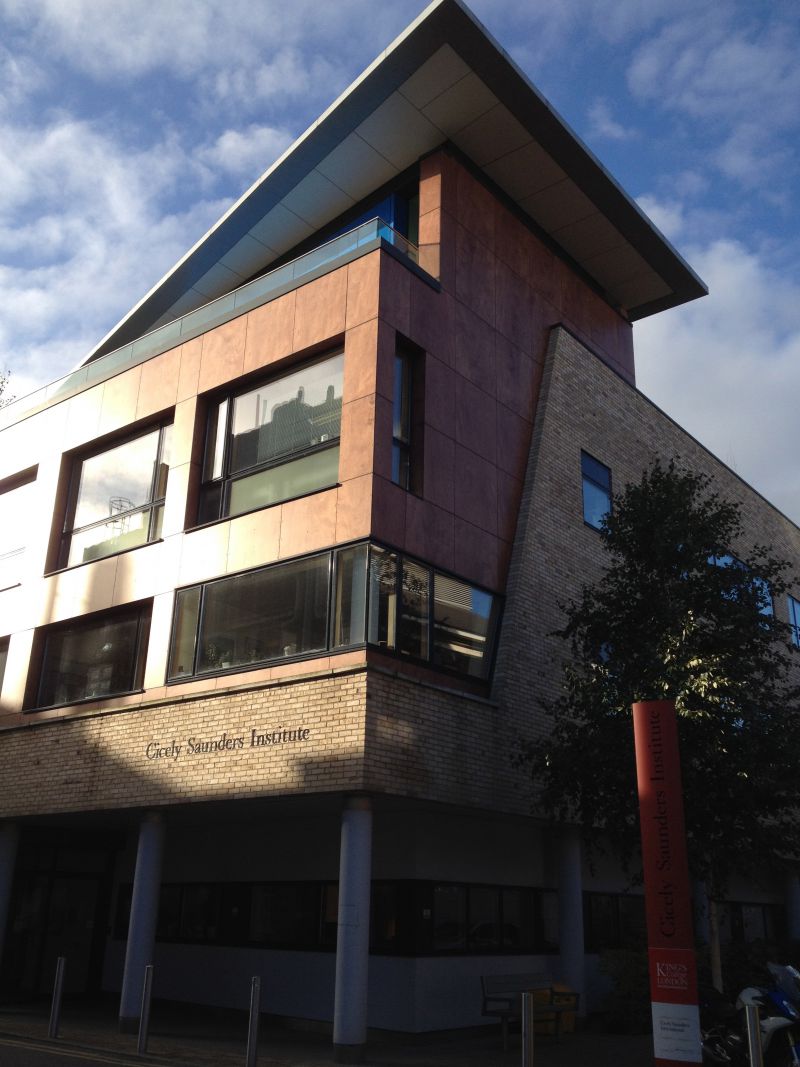
It's an exceptional structure with a wealth of experience. The researchers there devote themselves exclusively to their work: they are not, as I've seen in France, doctors who carry out scientific studies when their schedules and financial resources allow. In the same building, clinicians work on the one hand, and some fifty researchers on the other, which facilitates interaction. Within the institute itself, we find all the necessary skills: biostatisticians, linguists... all with real expertise in the field of palliative care. Many opportunities for exchange are organized: one day it's the juniors who present their studies, the next day we get together for a critical reading of articles, the day after a new development in palliative care is presented to us... The scientific efficiency of this organization is undeniable. In particular, it is reflected in the fact that the Cicely Saunders Institute manages to obtain horizon 20203 type funding, which is not the case for any French palliative care research team.
- Is England ahead of France in this field?
England is the cradle of European palliative care as we understand it today, thanks to Cicely Saunders4 who was a real pioneer. The culture of palliative care is therefore older (dating back to the early 1960s) and more developed than in France. Palliative care is an integral part not only of cancer care, but of all chronic pathologies. There are specialized mobile teams for pain, dyspnea, liver or kidney failure, etc. They work with all patients, whatever their pathology and how far they have progressed in the palliative stage. The general public is also better informed about this care, thanks in particular to numerous associations, and it is provided at an earlier stage. While France is struggling to develop the use of advance directives5, Great Britain is already engaged in advance care planning, in other words, a comprehensive understanding of patients' representations and expectations enabling appropriate decision-making at the end of life.
- Were there any other peculiarities, any other cultural differences that struck you?
Yes, it's the involvement of patients in research, and not just as subjects of a study. In England, it's very important to have an expert patient on a project's development committee. These so-called "partner patients" are individuals who are or have been affected by the disease or, if the disease is too incapacitating, one of their relatives. They receive research training and are asked to assess the relevance of a study, its interest and its acceptability for the patient population they represent. They are perfectly integrated into the research teams, to whom they bring a "concrete" point of view. It's a pity that we haven't developed this culture in France; I think the quality of our work suffers as a result, especially as the inclusion of expert patients is now a criterion for obtaining certain funding. What also differs in England is the way research is managed. Whereas in France the principal investigator is almost always a doctor, over there it can be a nurse (there is a doctorate in nursing), a statistician, a physiotherapist or even a social worker. The investigators' professional backgrounds are more heterogeneous, and I think this diversity of viewpoint is beneficial too.
- What are your goals for the future?
In France, there is no palliative care research center that is organized like the Cicely Saunders Institute, but I would like to succeed in replicating this model, i.e. developing research with dedicated funding and securing jobs for researchers trained in the particularities of our discipline. But I'm coming up against a number of difficulties, starting with the fact that obtaining funding is currently done by responding to less specific calls for projects, which doesn't make things any easier. We're working with other research centers in the Auvergne Rhône Alpes region to try and respond to calls for projects more systematically. It's only possible to access major funding (of the H2020 type) if you've structured a research chain upstream.
- What advice would you give to help you prepare for a research year abroad?
First and foremost: define your project carefully, discussing it with your supervisor beforehand, so as to maintain a common thread even if you have to work on several subjects. Secondly, opt for a renowned, well-structured laboratory, part of a university with an interesting research dynamic, because it's really very inspiring to discover these "racing stables". I set off with the crazy idea that my research grant would be enough, when in fact it barely covered my rent and registration fees. Living standards vary from country to country, and what may seem sufficient in Lyon is not so in London6! To top up the grant, I worked one weekend a month at the airport's on-call medical center. Finally, even if you don't have a perfect command of English, I think you should go for it anyway! There's nothing more effective than practicing it on a daily basis.
- Have you kept in touch with Cicely Saunder's Institute?
Yes, of course, I regularly attend their events and participate in the steering committee of the "LGBTQ" task force that King's College guides for the EAPC. There are real opportunities in this area to bring about improvements in the care of palliative patients, both in terms of their specific expectations and the support that can be offered.
For more information:
See Guillaume Economos' profile in our researchers directory.
More information about the Cicely Saunders Institute of palliative care, policy and rehabilitation at King's College:
https://www.kcl.ac.uk/cicelysaunders
Photo credit: KiloCharlieLima by Wikimedia Commons
- Diplôme d'études spécialisées complémentaires
- Regional health agencies (ARS) allow medical, pharmaceutical and dental interns to spend a full year in a laboratory in France or abroad, carrying out research work with a view to preparing a master's degree or thesis.
- H2020 funding is European funding. To find out more: https://www.horizon2020.gouv.fr/
- Cicely Saunders (1918-2005) was a nurse, social worker, physician and writer who developed the concept of palliative care in modern medicine, founded the first specialist palliative care facility and developed palliative care research.
- Anticipatory directives correspond to a written statement in which a person indicates the treatments and medical acts he or she wishes, or not, to have carried out if one day he or she finds himself or herself in an end-of-life situation without being able to express his or her wishes. (See an article on this subject on the Platform website)
- The grant provided by the ARS corresponds to the salary of an intern at grade 1, i.e. around 1,200 euros per month.
Published December 7, 2020
Author : Delphine Gosset