
Research Overview
<p>Annual overview of French research on end-of-life care and palliative care, compiled from the Research Observatory’s four databases: the National Directory of Researchers, the Directory of Research Projects, the Directory of European Projects, and the Directory of Theses.</p>
Annual overview of French research on end-of-life care and palliative care, compiled from the Research Observatory’s four databases: the National Directory of Researchers, the Directory of Research Projects, the Directory of European Projects, and the Directory of Theses.
The 2026 edition confirms continued growth, though this growth now varies by data set: the research community has stabilized at around 460 individuals, while research projects—and especially theses—have seen a marked increase.
The thematic classification was expanded with 8 new entries over the course of the year, reflecting the emergence of new research topics in the field:
464 people now report working on topics related to end-of-life care, compared to 456 in June 2025 and 312 in June 2020—a 48.7% increase over six years.
The net increase for the year (+8 people) is more modest than that observed between 2024 and 2025 (+21). This is the result of two factors: new registrations, on the one hand, and the removal of 11 profiles at the request of the individuals concerned, on the other. The network is therefore entering a phase of consolidation rather than expansion.
A robust update rate:
218 researchers—representing 47.8% of the directory—accessed their profiles during the 2026 campaign to confirm, correct, or complete them. This rate serves as an indicator of the reliability of the directory as a whole: nearly one in two profiles has been validated by its owner over the past twelve months. We would like to acknowledge and highlight the community’s efforts!
The community remains overwhelmingly female, with proportions that have remained stable over several editions.
This proportion is worth comparing to that observed among doctoral students (78.3% women among theses in progress, see section 6): the proportion of women is significantly higher at the start of their careers, suggesting that this imbalance will persist—or even increase—in the coming years.
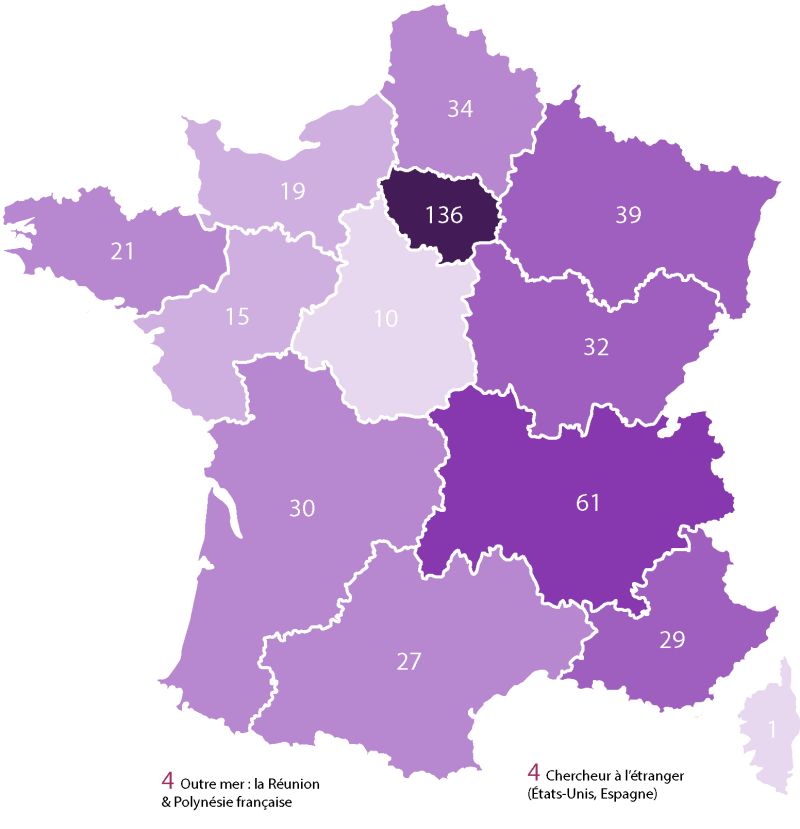
The concentration in the Île-de-France region remains strong: the region is home to nearly 3 out of every 10 researchers, and the top five regions account for nearly two-thirds (65.4%). Conversely, the overseas territories account for only 4 researchers, even though “overseas territories” has just been introduced as a research topic.
The subject therefore exists more as an object of study than as a site of scientific production.
66.8% of the researchers in the directory are affiliated with a research unit, and 139 conduct their work in a hospital or medical department.
The high degree of dispersion—176 units for 310 researchers, or an average of fewer than 2 researchers per unit—is a defining characteristic of the field: research on end-of-life care is largely conducted within units for which it is not the primary focus, by individuals who are often isolated in their laboratories. This is precisely what underscores the value of a national network.
Analysis of the data shows a predominance of qualitative methodologies, which nearly 60% of the research community uses. Mixed-methods research ranks second, ahead of quantitative approaches.
Cancer remains the dominant focus among the conditions studied (25% of researchers), far ahead of organ failure and respiratory or cardiovascular diseases, even though the latter account for a major proportion of end-of-life situations. Next, healthcare professionals constitute the most studied group in this field, ahead of older adults and their loved ones: French research on end-of-life care focuses at least as much on those who provide care as on people at the end of life.
The top three topics remain unchanged: end-of-life settings, care, and ethics. These are the three historical pillars of the field.
The most notable increase concerns the entry “Palliative Care” (134 mentions since its creation), indicating that a significant portion of the community defines itself primarily by its field of practice rather than by a specific thematic focus.
102 research projects are now listed, 10 more than last year. The directory has surpassed the 100-project mark for the first time.
Following the sharp slowdown in 2025, growth is picking up again. It should be noted, however, that this directory is populated at the initiative of the researchers themselves: its growth reflects both the vitality of the field and the effectiveness of the outreach campaigns conducted by the Platform.
Three out of four projects are currently underway, indicating that this is a living directory rather than a mere archive.
The distribution of start dates shows a marked peak in 2022 (21 projects), followed by an apparent slowdown from 2024 to 2026. This slowdown is partly an artifact of data collection—the most recent projects are reported with a delay.
62 out of 104 projects (60%) mention at least one funding source. The sources are highly diverse, and none supports more than a dozen projects.
This dispersion is the most notable finding: it indicates a field that is not backed by any major overarching program but instead draws on a multitude of modest-sized funding sources—national agencies, private foundations, local governments, and healthcare institutions. This is an objective argument in favor of the Interdisciplinary Research Program on End-of-Life Care.
Research on end-of-life care is conducted in roughly equal measure by universities and healthcare institutions, which distinguishes it from many other fields. This duality is an asset for translating research into practice, but requires methodological support mechanisms tailored to hospital teams.
Thirty-two European projects focusing on end-of-life care and palliative care have been identified, compared to 31 last year.
Horizon Europe now accounts for more than 4 out of 10 projects, with a clear wave of new projects set to begin in 2024 (EPIC, RAPHAEL, EU PAL-COPD, AI4HOPE, In-Touch, PsyPal). The topic of end-of-life care is thus firmly established in major European programs, including those focused on innovation (artificial intelligence, psilocybin, early rehabilitation).
The increase compared to 2025 is due solely to the Erasmus+ program (4 projects versus 1), which reflects both improved data collection and genuine momentum: professional training is emerging as a structured European priority (NursEduPal@Euro, NursEduPal@IMPACT, RESPACC, SPES4Caregivers).
Next year, this list will be expanded to include the results of the two ongoing calls for proposals: HORIZON-MISS-2026-02-CANCER-04 “Earlier and more precise palliative care” and HORIZON-MISS-2026-02-CANCER-07 “Improve the Quality of Life of older cancer patients.”
The contrast with the national community’s presence (464 researchers, 102 projects) is striking: France is well represented in European end-of-life research, but almost exclusively as a partner rather than as a coordinator. The countries that serve as coordinators—the Netherlands, Spain, and Belgium—are precisely those that have dedicated, long-standing research centers (End-of-Life Care Research Group, Radboud, Leiden).
17 dissertations were defended in 2025, the highest number since the database was created, and more than double the number from the previous year. The cumulative total since 2019 rose from 73 to 91 defenses (+18 in one year, compared to +14 the previous year).
At the same time, the number of theses in progress increased from 92 to 106 (+15.2%). The field is thus experiencing both a record number of completed theses and a growing backlog: this is the most positive indicator in this edition.
The apparent decline in new registrations in 2025 (14 versus 21) should be interpreted with caution: recent enrollments appear on theses.fr with a delay, and the 2025 figure will likely be revised upward in the next edition—as was the case for 2024.
Of the 197 theses surveyed, 75.6% were written by women. The proportion of women is higher among currently enrolled doctoral students (78.3%) compared to theses that have already been defended (72.5%).
The dominance of social sciences and humanities (SSH) laboratories is increasing (84% of theses in progress, compared to 81% last year). Compared to the balance observed in the directory—52% humanities and social sciences / 48% medical sciences—this proportion reveals a marked imbalance in the doctoral pool: the next generation is being trained overwhelmingly in the humanities and social sciences, while half of the current community comes from the medical sciences.
=> The development of a doctoral program in medical sciences and nursing is a medium-term challenge for maintaining balance in the field.
Psychology dominates by a wide margin (43 theses in total), followed by law and ethics. Furthermore, the field of law shows the strongest growth, with 18 theses in progress compared to 8 defended. The current legislative debate on end-of-life care appears to have spurred a marked increase in doctoral research in this area.
No institution has produced more than 10 dissertations over seven years: doctoral training in end-of-life care is as scattered as the research itself. Aix-Marseille University appears to be the most dynamic institution.