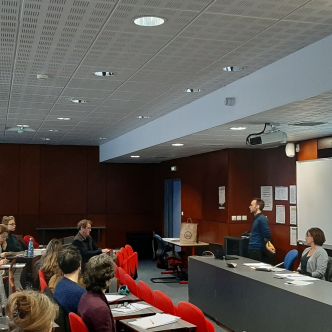
On October 7, seven young researchers working on end-of-life and palliative care issues presented their work at an online seminar organized by the Platform.
As part of the Penser la pandémie virtual seminar organized by several laboratories at the Université de Franche-Comté, Elodie Cretin, coordinator of the COVIDEHPAD study, looks back at the extraordinary context in which this project was set up.
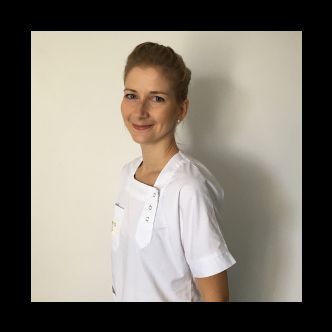
Maud Fontaine is conducting research into the media coverage of end-of-life issues, alongside her training as a nurse. Portrait of a young woman with an unusual career path.
Lassitude of living, requests for euthanasia, suicide... The desire to die expressed by some elderly people raises questions. The place given to them in our society is no stranger to this phenomenon, as philosopher Eric Fourneret and sociologist Frédéric Balard explain in a joint interview.
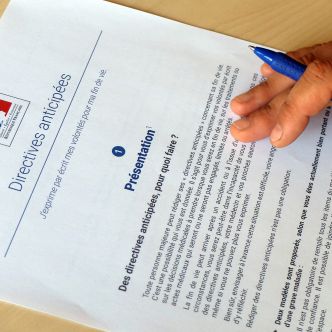
As part of their thesis, three young GPs have chosen to tackle the issue of advance directives, each from a different angle. Their investigations with patients, professionals and healthcare institutions have led to suggestions for increasing the use of this mechanism, which is still under-utilized.
The Plateforme nationale pour la recherche sur la fin de vie and the Réseau québécois de recherche en soins palliatifs et de fin de vie (RQSPAL) have agreed to offer two mobility grants to doctoral students. Maya Corman is the French winner of their call for applications. Portrait of a young psychologist full of initiative.
Hélène Trimaille, 31, is a study and research engineer at the Clinical Investigation Center (CIC) of the University Hospital Center (CHU) in Besançon. As part of a team whose research focuses on ethical issues relating to aging and the end of life, she works in close collaboration with palliative care and geriatric medical services.
The situation of people living in EHPAD is one of the many issues raised by the coronavirus epidemic currently sweeping the planet. The Plateforme nationale pour la recherche sur la fin de vie is coordinating a qualitative study to understand this crisis situation and draw lessons for the future.
One of the objectives of the Plateforme nationale pour la recherche sur la fin de vie is to encourage the emergence of local multidisciplinary research. Auvergne-Rhône-Alpes is one of the regions where such collaborations are taking shape. Since last year, three research projects involving medicine, the humanities and the social sciences have been launched.
The Plateforme nationale pour la recherche sur la fin de vie and RQSPAL offer financial support for doctoral students working in the field of end-of-life and palliative care research. Two fellowships are available, one from Quebec (5000 Canadian dollars), the other from France (3500€).
On December 4, the founders of the Association des étudiants et anciens du master 2 Recherche en médecine palliative et sur la fin de vie (AssEtAM) (Association of students and alumni of the Master 2 Research in Palliative and End-of-Life Medicine) held their constituent general meeting on the occasion of the Scientific Day of the Plate-Forme Nationale pour la Recherche sur la Fin de Vie (National Platform for End-of-Life Research).
Recent work in the biology of aging has identified markers that predict natural death in certain animal species. This research opens the way to possible extrapolation to humans, raising thorny ethical questions..
On March 28, 2019, Dominique Libault submitted a report in response to a mission letter dated September 17, 2018, from the Prime Minister to conduct a consultation and make proposals for reform, particularly with a view to a bill. A wide-ranging national consultation has enabled proposals to be drawn up with the people and players concerned.